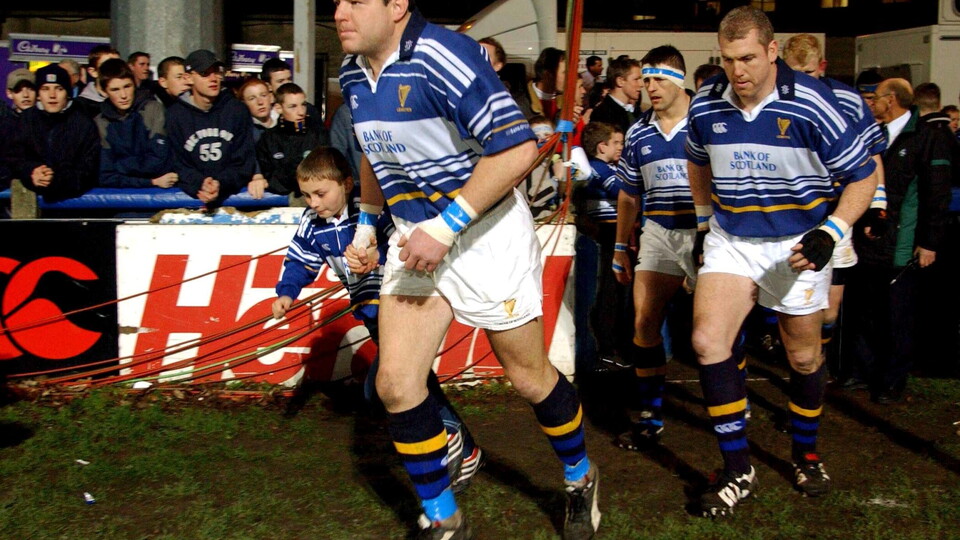
THEN: Led Leinster to their first major trophy, the 2001/02 Celtic League title, in a 10-year career that returned 136 caps for Leinster and 47 for Ireland.
NOW: Sunshine 106.8FM Radio Show host, Premier Sports Guinness PRO14 commentator and co-owner of Brightwave Solutions.
There was a time, not so long ago, when Leinster Rugby found trophies hard to come by.
Before the first of the four Heineken Champions Cup stars could be embroidered onto the shirt, there was much toil by many for little reward.
That was until the 2001/02 Celtic League final, played just before Christmas that season, when Reggie Corrigan led Leinster to the inaugural title.
It all came about in the most unexpected circumstances as Eric Miller was red-carded in the 25th minute to put Leinster in a hole they climbed out of due to a collective willingness to go the extra mile in a 24-20 triumph.
Ever since, that standout moment has been depicted as an exception to the rule that Leinster just didn’t come through in the clutch.
Something that still rankles with Corrigan: “I don’t know if it did prove to be a false dawn. I sometimes get annoyed with people’s descriptions at how Leinster never did anything for many years.
“We won the first Celtic League title in front of a crowd of 40,000 with 14 players. I always see that as being a major achievement. I suppose, because we won that one, everyone thought everything else would all fall into place.

“I think that does a huge disservice to the other sides that were around at the time, how hard you had to work to win something. Swansea were in their pomp. Glasgow was a tough environment to win. Even places like Ebbw Vale, Bridgend, Newport, Pontypridd were far from easy. Ulster were at the top of their game after being crowned Heineken champions in 1999; Munster making the Heineken final in 2000 and 2002. Every match was a battle. There were no soft touches in that league.”
The onset of Covid-19 caused people to ponder the past and Corrigan even took the time to have a look back at that Celtic League final.
“I watched it there recently. There was an amazing collection of Irish players involved in that match. I was almost worried to watch in case it aged badly. In fact, it was phenomenal quality.”
Captain Corrigan eventually retired from playing in 2007 with 136 caps for his province and 47 for Ireland. He stayed inside the game as a scrum coach, originally part-time with Matt Williams up in Ulster and then for Michael Cheika at Leinster.
Now 50, the former loosehead prop has kept in touch with the game through his punditry for a variety of outlets and his work for the last two years as a lead commentator for Premier Sports, primarily for the PRO14 matches played in Scotland, Wales, Italy and South Africa.
In addition, there is the popular co-hosting of Sunshine Radio’s (106.8FM) programme Dublin’s Talking Sport with former World Snooker champion Ken Doherty.
Covid-19 has even prompted Corrigan to sometimes go it alone as Doherty, still active on the professional circuit, has not always been available.
“I have been doing the show for seven or eight years. I’ve known Ken for a long time and he originally asked me to come on as a guest contributor for the rugby.
“Then, Ken suggested I come in to co-present the show as a different dynamic. I have been doing it ever since. It is a double-act. There are two of us in it. I love it. It is a really good show, covering everything rugby, GAA, soccer, horse racing, golf and so on, more as a chat than an in-depth analysis.”
The worldwide pandemic has also led to an opportunity for Corrigan to delve into the business world. He started up Brightwave Solutions, a company devised to come up with technology to future-proof against other outbreaks, centred around installing temperature screening solutions to companies and schools.
Those years grinding it out in the game have given the Wicklow man a solid grounding in many of the finer points of achieving his goals.
“I took a lot of what I learned from rugby into my working life around problem solving, coming up with strategies, working in a team environment, understanding people,” he said.
“For instance, I would have been captain of Leinster for four years and on leadership groups all the way through my rugby career. You very quickly learn about how to read people and the social skills in interacting with them.”
He is also realistic about how much the game has changed and how he is on the outside looking in.
“I’m very wary about giving my opinion on rugby anymore. I’m conscious of the fact I’m 13 years out of the professionalism. It is not the game that I knew. I don’t feel I have a right or the insight to comment on what goes on inside a dressing-room because I don’t know. I back away from that now.
“Rugby is a very different game now to what it was when I played it, entirely different. I don’t buy into it being tougher. It was a hard game in the 1980s and 1990s but the techniques, training and science behind what Leinster do now is so different.”
Perhaps, Leinster’s greatest virtue has been how the organisation has changed with the times, catching-up, adapting, overcoming.
“I have nothing but admiration for what Leinster have achieved, where they have gotten to. I just hope they can sustain it. In terms of a team to look at and hold up as a standard, it is phenomenal, what they have done.
“I think, to bring it back around, that has been evolving since my day, even before my day. In order, for good organisations to succeed in the long-term, you’ve got to be able to take the bad times, like the 2000 Heineken Cup semi-final loss to Perpignan and 2003 defeat to Munster, and learn from them.
“I think they have done that brilliantly. Even though Leinster waited until 2001 for their first trophy and 2008 for their second, they used the Perpignan and Munster losses as lessons. You had to move on and do your best to not let them happen again.
“Of course, it isn’t perfect. You never stop learning. You never stop evolving. No team or club can ever stop and think they have it all figured out. But, in terms of where Leinster have gotten to, the brand they have developed, the organisation as a whole, it is phenomenal.”