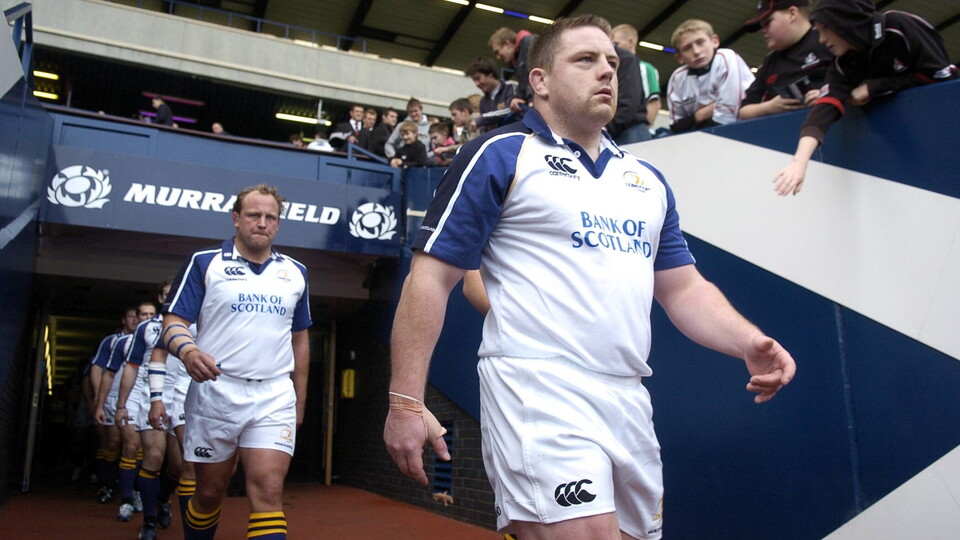
THEN: Ronan McCormack made his Leinster debut at 27 before playing for five seasons, winning 52 caps, from 2005 to 2010.
NOW: The Managing Director of Grayling Property Management lives with his girlfriend Melanie and their children Ryan (5) and baby Tristan in Dundrum.
“Is it Ronan or Ronnie?”
“It’s Ronan. A lot of people assume it is Ronnie. Only in rugby do people call me Ronnie.”
“Well, for the purposes of this conversation, will we try Ronnie again?”
“Yeah, that’s fine,” he laughs.
******
Ronnie McCormack took an unusual path to get back home, travelling around the provinces to eventually make his Leinster debut at 27.
He had gathered an early profile from playing his part in St Mary’s College’s Leinster Schools Junior (1992) and Senior (1994) Cup triumphs as well as from representative honours for Leinster and Ireland Schools.
In 1994, the IRFU operated the Ireland Foundation, a centralised predecessor of the Academy system. Ronnie did not get beyond a limited screening process in which more than 100 bodies were whittled down to 10 or so.
“It wasn’t a very scientific approach back then. Once you didn’t make that cut, you were excluded from having an opportunity with one of the provinces,” he says.
The opportunity to join the professional ranks came on the back of UCD’s rise through the All-Ireland League Divisions.
That was where Ronnie earned his stripes against the gnarled, hard-nosed veterans that roamed those plains, a familiar theme in the late 1990s and early 2000s.
Back then, Connacht always had to be creative in how they manned their roster. In 2000, Steph Nel doubled-up as the Irish Students coach and it was in this role that the South African spotted an under-appreciated prop, leading to a two-year deal
“It was an opportunity to test myself in the professional game, something that became more tempting as I grew more comfortable in the AIL,” he said.
He played 26 times for Connacht over two seasons, winning caps at the Ireland ‘A’ level where he manned a front row with Ulstermen Paul Shields and Simon Best, older brother to Rory.
When Justin Fitzpatrick left to play in France, Ulster had a hole in their front row and the IRFU supported the move because Ronnie was going to be playing in the European Cup, as opposed to the Challenge Cup.

“It all made sense to me. It was a progression, in terms of money and the chance to see how far I could go,” he adds.
“Plus, I also went up to Ulster to spend a day with their coach Alan Solomons. That was all I needed to make the move. I felt it would be a step-up in terms of their players and facilities.”
Two years, and 37 caps, later, Ronnie had another decision to make. Ulster had offered a new three-year contract and Leinster’s response was to match it.
“My preference was to play for Leinster. It meant coming home. When I was at Connacht and Ulster, I always felt I was bound to move on.
“It meant a lot to get that contract. I immediately felt at home. At 27, I wasn’t interested in moving beyond Leinster. It would be my last club for as long as it would last. In the end, I played for five seasons and that was it.”
Ronnie made his Leinster debut at loosehead against Ospreys in September 2005, sharing that experience with coach Michael Cheika and Rob Kearney too.
In fact, the Australian coach ushered in wholesale changes, nowhere more prominent than in the front row where Bernard Jackman and Englishman Will Green were also new to the regime.
“I hit it off with Cheika. He did have a reputation as a hard task master. I think he was frustrated with what he saw at Leinster,” shares McCormack.
“What he saw is what everyone knows. Loads of talent with loads of issues. I am not sure if I can put my finger on what they were, exactly. I was in the middle of it.
“Was it the attitude of the players? I don’t know. There is not one person I can point to and say, he had a terrible attitude.
“Culture is a word that is thrown around. We are all sick of hearing that. But, Cheika had to change it at Leinster.
“In a strange way, there was an acceptance that we knew we had a lot of talent, but that we wouldn’t win anything because there was something missing.
“Something had to change. Cheika basically came in and did it his way.
“As far as I could see, he gave everyone a fair go of it. He was hell-bent on turning the talent into winning trophies.
“You had Gordon D’Arcy, Brian O’Driscoll, Denis Hickie, Shane Horgan, Girvan Dempsey. In the forwards, you had Eric Miller, Reggie Corrigan, Malcolm O’Kelly, Keith Gleeson. The list was endless.
“It all began to change in that first season, probably best illustrated by beating Toulouse in the 2006 Heineken Cup quarter-final in France before Munster showed us how far we had to go in the semi-final at the old Lansdowne Road.”
In that first season, Ronnie started four times in 19 appearances, ramped up to 14 starts from 15 caps in the second season, all but one of them coming before the turn of the year.
Then, lightning struck not once, but twice in two months.
First, he left injured with a neck injury in ‘The Last Stand,’ the match played between Leinster/Ulster and Munster/Connacht combinations around Christmas 2006 before Lansdowne was torn down.
“That changed everything. I was never able to get right from that,” he admits.
Ronnie tried to play through it, only to come a cropper against Edinburgh in his first match back in mid-February 2007 when a routine tackle turned into something serious.
“I remember it well. I just got tackled from behind. My elbow hit the ground and my chest followed with a guy landing on top of me. My shoulder was in bits.
“I had two surgeries, the second to re-attach a torn bicep. It took a full year to get back.
“But, I can trace the beginning of the end back to that neck problem. It is just the shoulder almost made me forget about the neck.
“When I eventually got back to playing in the 2008-09 season, the year we won the Heineken Cup, I was reasonably okay at the beginning of the season. My shoulder was fine again.
“But, we were doing a warm-up in the RDS and I went head-first into Dev Toner’s hip. I got a compression down my neck.
“It was the very same feeling I had when I came off in The Last Stand. I nursed it through the rest of the season, coming off the bench a lot. It was never right and I played so little from then on.”
When Joe Schmidt took over from Cheika, Ronnie was never able to put his best foot forward, starting his last three caps, spaced out between October and December 2009 and April 2010.
“It is the very same injury that nearly forced Cian Healy to retire. Somehow he found his way back. Maybe, he had a lot more to play for. I couldn’t do it. When the end came, there was nothing else I could do.”
It was all over in 2010. Thankfully, Ronnie had started a Master’s in Sports Management earlier that season. As luck would have it, he had John Fogarty and Bernard Jackman for company to ease the transition.
He set out to work in the Residential Property industry and is now Managing Director at Grayling Property Management, living with his French girlfriend Melanie and children Ryan (5) and baby Tristan in Dundrum.
“These days, the strain comes from bottle-feeding a newborn baby. It can be helpful when it comes to avoiding the night feeds,” he laughs.