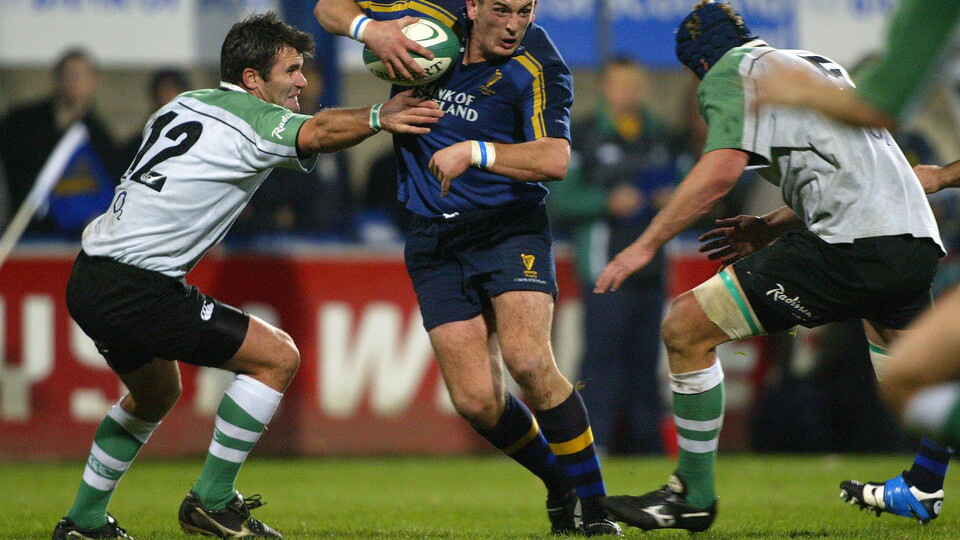
THEN: James Downey played one season for Leinster, turning out nine times in 2003/04 before moving on to a solid career at seven clubs, the highlight of which was an Ireland cap against Canada in 2013.
NOW: James is a Player Manager with Sports Management Company Esportif and lives with his partner Kate in Portmarnock.
It is a story often told about how Leinster Rugby used the protective shell of the half-time dressing-room to bring about ‘the greatest comeback’ in the 2011 Heineken Cup final.
In the immediate aftermath, Brian O’Driscoll loaded the ‘kudos’ onto Johnny Sexton, while the forwards were more inclined to heap praise on Greg Feek’s ability to adapt to what was happening to the Leinster scrum.
Whatever about the truth of the matter, what about the other side of the story, at the other side of the wall.
Northampton were taking a moment to inhale the audacity of having wiped the Millennium Stadium’s surface with Leinster, drilling them into a 16-point (22-6) hole.
And there was a Dubliner right there in the middle of it all. Leinster old boy James Downey was four seasons into his stay at the Saints.

Did the Saints think they had it won? Were they undone by their own faulty belief system?
“We never thought we were home and hosed. We knew the calibre of Leinster. We knew they were going to hit back.
“We were pretty relaxed. I remember just saying, ‘We need to get the next score’,” James recalled.
“In the second-half, we just had to stem the tide. We needed to stop the momentum, settle down, kick three points. We had to weather the storm. But, the storm kept blowing.
“It was just one thing after another. We were on the ropes taking punches until we were on the floor.”
He chose to leave that memory behind a long time ago because moving on is partly about not looking over your shoulder.
“During lockdown, they have been showing replays of that final all the time on Sky Sports.
“I won’t lie. I have never watched the game back. I have no interest in that, whatsoever,” he admits.
Downey was, literally, at the centre of the argument, in teaming up with Jon Clarke to subdue and stress the vaunted pair of Gordon D’Arcy and Brian O’Driscoll.
There was a time when the Drumcondra man was vying for match minutes with D’Arcy and O’Driscoll.
In 2003, it came on the back of Downey’s form for Clontarf in the All-Ireland League, new coach Phil Werahiko adding to the squad and to the centre’s confidence.
‘Tarf got on a roll that only stopped when they were beaten 18-8 by Ballymena in the All-Ireland League final.
The profile the AIL offered was high enough to make Downey a person of interest to Leinster coach Matt Williams and discussions took place
“I remember Ken Ging, the Leinster Manager, rang me and asked me to come into training towards the end of that season,” says James.
“At the time, I had talked to Conor O’Shea at London Irish and there was a loose agreement made to move to London.
“But, I talked to Matt Williams and I wanted to stay home and play for my province. A contract was verbally agreed for the next season.
“When Matt left, I fell between two stools, going from having two offers to none.”
The best Downey could do was to secure a training contract for 2003/04, his only season to play for Leinster.
“It was a couple of hundred quid a week. All the young lads were praying for win bonuses and match fees, sitting on the bench counting the money in your head as you waited for a chance to play.
“They were different times, very different.”
It was a World Cup season. While the Ireland headliners were away, the youngsters could play.
Downey made his Leinster debut as a 79th-minute replacement against Cardiff Blues in October 2003.
From there, there were three straight starts in the same month against Connacht, Border Reivers and Glasgow. That was as good as it got, the remaining five caps coming off the bench.
“It was the year Gordon D’Arcy moved to centre because there was a shortage there with just Dave Quinlan, Gary Brown and myself. Brian O’Driscoll and Shane Horgan were at the World Cup.
“I do remember my first start in an interpro against Connacht. That meant a lot. It is just the crowds in Donnybrook weren’t anything like they are now at the RDS.
“I was very nervous that day. What made it slightly easier was the fact I knew some of the Connacht guys because I had played against them in the AIL.”
By the conclusion of the month, Downey had racked up three starts, going the full 80 minutes twice and 68 minutes once.
“I felt comfortable in that environment and with those players. It was a case of ‘stay and see what happens’ or move for more opportunities to play.
“You always wanted to wear that blue and I loved wearing it. I would have loved to have been a one-club man, stayed there my whole career. But, that wasn’t realistic.
“I have a personality where I wouldn’t have been happy within myself to have stayed and sat on the bench. I was conflicted.
“Should I have been more patient? Was I too impulsive? In the end, it came back to one thing. I needed to move to play,” he says.
“It took me a while to come to that decision. Look, I don’t think Leinster were too worried about losing me.”
It led to the first of many moves to Connacht (2004-2006), Munster (2006), Calvisano (2006-2007), Northampton Saints (2007-2012), Munster (2012-2014), Glasgow Warriors (2014-2015) and Wasps (2015-2016).
In 2006, Connacht were struggling in the Celtic League when Downey’s contract was not renewed after two seasons.
“I was thinking if the club that is near rock bottom of the league doesn’t want me, where am I going to go?”
He salvaged a dying career by calling his old Ireland U-19 coach Declan Kidney and offering to train for free at Munster.
It provided enough playing experience from three appearances to make his way to Italy where he got back his love for the game with 18 caps for Calvisano.
Even so, he was contemplating retirement when the chance came along to move to Northampton in 2007.
“David Quinlan, my Leinster teammate, was there. He had to retire with a neck injury and he was kind enough to recommend me.
“When I went to Northampton, I clicked with the coaches Jim Mallinder, Dorian West and Paul Grayson straight away,” he states.
“I loved it there, from winning promotion out of the championship to playing week-in, week-out in the Premiership and in the Heineken Cup.”
It lasted five years. Why leave?
“I could have stayed. I got to the stage where I wanted to give it a shot to play for Ireland. Munster came in. And that was it.”
The lure of an Ireland cap grew stronger over time and three appearances for the Irish Wolfhounds further fed the temptation to return home.
“When I came back in 2012, I got one cap against Canada on the 2013 summer tour. That was unbelievable. That was, to me, the ultimate,” declares James.
“It reinforced the journey I had been on, showing the resilience to keep going. It made the decision to come back, the right decision.”
When the end came, Downey thought he was ready for a career move. He wasn’t.
One day a week in an insurance company in his last year of playing at Wasps and a year in an investment firm in London told Downey all he needed to know about ‘the office’.
“I thought I was the most prepared person to finish until I sat down in an office in a suit. I found that so hard.”
He fell into the trap of doing what he thought he should do, not what he loved to do. He wasn’t going to make that mistake again.
When Downey really thought about his future, it all came back to the game itself. He sought advice from long-time sports consultant Dave McHugh and, eventually, an opening came for a Player Manager, or rugby agent, in sports management company Esportif in 2018.
“Personally, my experiences as a professional player are huge for my work,” he shares.
“When players are going through a bad time or they need to resolve a problem with a coach or they are thinking of moving clubs, I know what it is like. I have been there.
“I can give my advice, oftentimes, from personal experience, and I like to think players can trust that.
“This job is all about trust and building relationships. I have a widespread list of contacts from my playing days. I like to think I have a good name in the game. I really do.”
“I can talk to a player and empathise with what they are going through. I had my share of injuries, selection issues and setbacks.
“It is crucial to be able to show how you have been in their boots and, maybe, how you can help them make the best of their careers.”
It all comes back to making a difference.
“I love what I do. I absolutely do.”