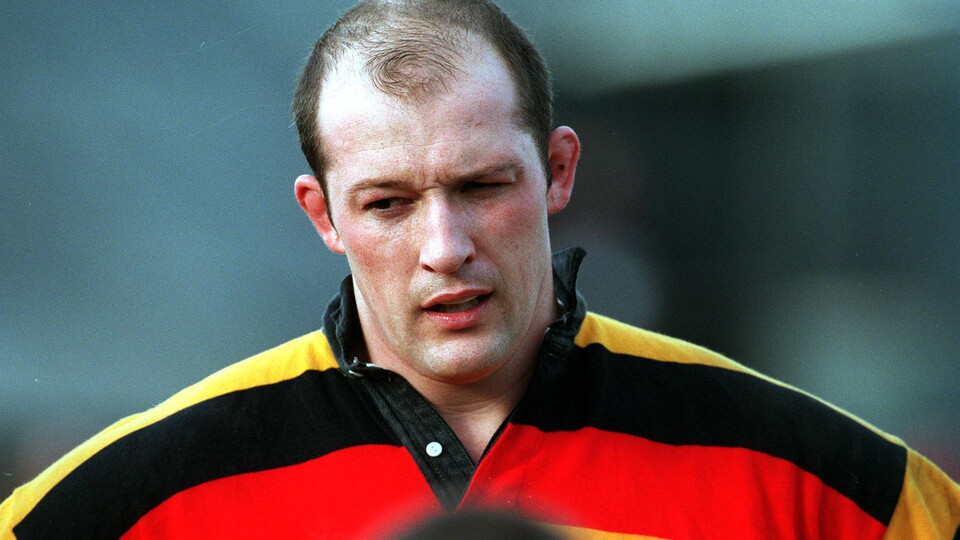
THEN: Lansdowne lock Paul O’Connor played twice for Leinster and five times for Munster in the 1990s.
NOW: Paul and husband Dominic live in Wicklow, owning the bike section at the swimming, cycling, and running store ‘Base2Race’ in Ballymount, Dublin 24.
It was June 3, 1997, a morning like most others, when Paul saw his father for the final time.
Always on the move, Rory O’Connor was convinced by a friend to take a trip out west to scrutinise a build of properties in Mayo.
Somewhere near Ballyvary, between Swinford and Castlebar, the car hit loose chippings on the road, spun out of control, into and through a ditch.
The driver survived; Rory didn’t. He was five days short of his 55th birthday.
Back then, the Irish Times referred to Rory as ‘one of Lansdowne rugby club’s most vociferous, outgoing and lovable characters’.
It was certainly an apt description for the depth of feeling that coursed through wife Eileen, daughters Suzanne and Deirdre and sons Stephen and Paul.
“It was horrendous – a day I will never forget,” says his son Paul.
This was a time of heartbreak and, soon, a catalyst for change.
Paul, the hard-playing, hard-drinking Lansdowne second row forward, was gay.
“Dad’s passing was an eye-opener. It made me realise we are here for a short time,” he says.
“I was hiding for so long. I had to get out there and find that somebody special.
“I had missed out on many years of being true to myself. The banter with the lads at Lansdowne was often around who they were with at the weekend.
“I couldn’t take part in any of that. That was the way it was.”
Not long retired from the game, Paul finally felt free to express his sexuality.
“It would have been unthinkable to be openly gay as a player. I never confided in even one person until I was 31,” he declares.
“There are plenty of other guys that have gone through it. You tried not to think about it. Just got on with it.
“Don’t get me wrong, I had a great time with the lads. We were like a family. We were very close at Lansdowne.
“It remains that way to this day,” stresses Paul.
“Let’s be clear, in the comments here and there at the club, there were homophobic slurs that I let go. I never said anything, but I never joined in either.
“I was well conscious of the fact rugby was a male, testosterone-driven sport where homosexuality wasn’t, shall we say, expected.”
“In fact, rugby became my escape from it,” he admits.
“I enjoyed the social side of the game, often leading the charge by organising nights out and being right at the centre of the shenanigans.”
As a player, Paul was able to build on representing Leinster Schools, U-19s and U-20s to play two matches for Leinster, the first against the Exiles and the second against a touring Scottish outfit.

“It was great to play at representative level for Leinster. I was very good at the lineout and in the scrum too. But, I was not the greatest around the field,” he concedes.
“I was on the Lansdowne team, with the exception of two games for which I was dropped, from 1986 to 1998.
“This was mostly back in the days when the All-Ireland League had a much higher profile than provincial rugby.
“I was the youngest on the team for years and then the oldest for a few years.”
Around that time, Sky Sports were pursuing the rights to showcase English club rugby and part of the procedure included broadcasting matches from Ireland, Wales and Scotland.
They were contractually bound to cover two All-Ireland League matches, the second of which was Lansdowne away to Garryowen.
Munster stalwart Colm Tucker happened to be on hand to see a powerful performance from O’Connor in which the 6′ 7” jumper dominated the lineout.
“Yeah, I had a stormer that day. I caught everything Mark McDermott threw my way and took some of Garryowen’s ball too.”
It led to playing five matches for Munster, one as the only non-international in the pack away to Castres in the Heineken Cup, two in Italy and an interprovincial against Ulster which was attended by no more than 600 supporters.
“How times have changed.”
However, O’Connor was primarily Lansdowne’s main man at the lineout and, gradually, the price for silence around his sexuality was proving costly.
“I had my own needs. It felt like I was doing my penance on earth,” he laughs.
“In many ways, I am jealous of the guys in my position these days. The conversation around being gay is so much more positive.
“Every time you jump ahead 20 years, you see such massive strides taken in society,” he stresses, during ‘Pride’ month.
In 1998, Rory’s demise prompted the decision to open up to a more authentic life.
“At that point, I just had to do something about it,” he says. “I wasn’t seeing anyone or going anywhere where I could meet anyone.”
One night, O’Connor made his way to The George where he was spotted by the brother of a friend.
“The issue was forced too. I got a phone call from one of the lads, Brian Glennon.
“He said: “Were you out at the weekend?”
“I said: ‘Yeah, why?’
“He said: ‘You were spotted by somebody in The George and it’s all over the place.’”
All of a sudden, the phone started going and it was all positive support coming in from all over the place, even though there was a lack of understanding about what it means to be gay.
“When I first told a couple of mates, one even said to me, ‘How could you be gay? I’ve seen you drink 30 pints on a Saturday night?’
Within a year of coming out, Paul met Dominic in 1998. They moved in together within six weeks and moved to Wicklow town in 2001. They formed a civil partnership in 2012 and married five years later, to the day.
An interest in triathlons sparked conversations with friends over a period of time around opening up a retail, coaching and treatment centre, catering to swimming, cycling and running.
This is where the business ‘Base2Race’ was born.
“Not only are we married, we are also partners in business together for the last 10 years,” he says.
“I was out of rugby for quite a while before the business was set up. It was a big step.
“We opened the shop in 2010, the day after the austerity budget. It was a big chance to take.”
The commitment to moving from sales and finance into a new career even removed the chance to travel back to the club he still holds dear.
“I have even accepted that I can’t make it to Lansdowne’s All-Ireland League matches as often as I would like because our busiest day is always a Saturday.”
O’Connor cites ‘teamwork’ as the most valuable asset he has taken from the game and applied to his work.
“At Lansdowne, it was always about the team. That is where it started and finished. I always felt we were a lot more than just a bunch of individuals.
“But, I have always been a fairly outgoing person anyway. It is just another sales job, except you are not reporting to the boss, you are one of the bosses.
“It is very much a swim, bike and run shop. Those three elements are broken into three separate entities, all under one roof.
“We all have our own areas of speciality. My area with Dom is the cycling section. There are also the running and swimming sections. In addition, we also have a coaching section and physiotherapists. It is a big operation.
“We all came together like one team to make that happen.”
The change of career direction has coincided with a dedication to a better lifestyle.
Paul is looking forward to an eighth Ironman in Sacramento, California this October.
It even led one friend to ask the question: “Why didn’t you train like that when you played rugby?”
Maybe, who he is as a man, is not who he was as a player.
Imagery: Inpho