Leinster Rugby is vying for the attention of the province’s best athletes.
The challenge changes as you move out of the rugby hotbeds in Dublin, to compete with the Gaelic games’ heartlands.
GAA has always attracted the eyes of those steeped in its culture and, more recently, Australian Rules Football has taken away elite prospects from the association – and from Leinster.
Leinster and Ireland U18 Clubs internationals Conor Nash (2016, pictured below) and Fionn O’Hara (2021) moved to join Hawthorn in Melbourne rather than stay and play for Meath and Westmeath, respectively or chance their skills in the Leinster Academy

“We are competing for their hearts and minds,” says the Head of Rugby Development Phil Lawlor.
“As a sport, we can’t afford to lose anybody. We have to be coordinated and collectively driven towards delivering for players and coaches.
“Players have greater access to information and they see what other sports are offering, they have sporting ambitions and with that comes greater expectations,” he says.
The clubs that embrace their youth pathway see the benefits in their adult set-ups. It is really interesting to see the age-grade rugby community in competition, and how clubs are developing their players.
The importance of the youth pathway can be so clearly seen in the number of players that are playing first fifteen for their clubs and other clubs across the province.
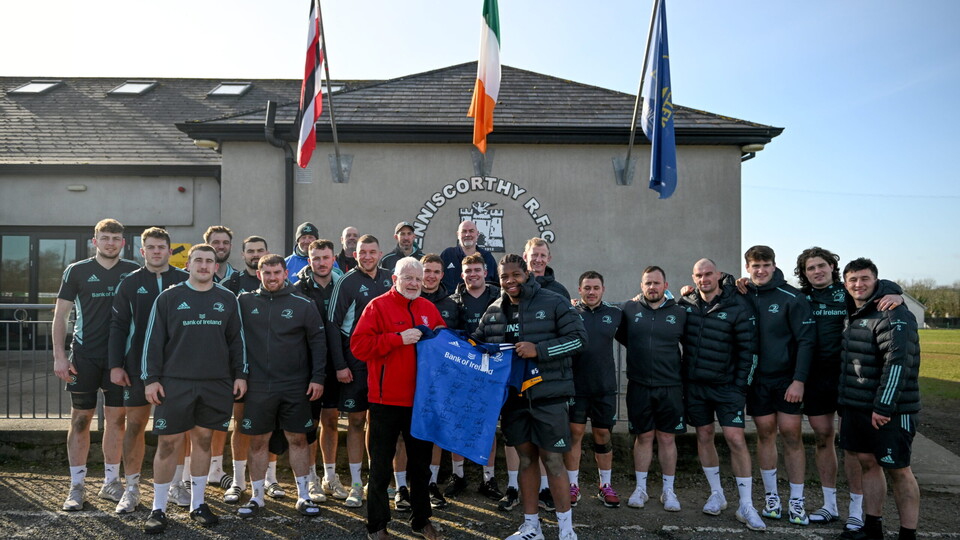
“From a Leinster Rugby view, in the beginning, there used to be a Dublin-centric feel to the AIL. But, you have Enniscorthy, Naas, Tullamore, Navan, Skerries, MU Barnhall from outside the M50 all playing in the All-Ireland League now.
“All those clubs have very good age-grade, youths programmes. It is no coincidence they have been able to progress from Leinster League to AIL club rugby.”
Where there is proof of progress there is also evidence of regression as clubs struggle to provide the resources to match the ambition of some of the better prospects in the game.
“The other side of that is there have been plenty of examples of where the focus hasn’t been multi-faceted,” says Phil.
“The focus has just been on one particular element of the club, the senior team, and everything else has failed because of that.
“Every club needs players graduating from Age Grade rugby, the Tom D’Arcy Cup, to the senior ranks every year. Otherwise, there is a limit on how long the club can perform at its’ current level both in numbers playing and quality of players.
There is a myriad of reasons why players don’t move into the adult section of their club, but if the environment is fun enjoyable and healthy, there is every reason for them to stay.
A club that is aligned from mini-to-adult will be seen as a club that can provide the right experiences for players and coaches to fulfil their ambitions.
“The quality of what we are producing in the Leinster club system allied to what the Leinster Rugby Department is doing to identify and develop those players has been good.
“As already outlined, it needs to evolve. We need to look again at what we do and see how we can add further value. This needs greater investment from all stakeholders IRFU, Leinster and the Clubs
“If you look at those players in a Leinster and Irish context that have come through the club system, they are players who make a big difference on the pitch, players like Tadhg Furlong, Sean O’Brien, two British & Irish Lions.
“Then, you look at Ciaran Frawley and Jamie Osborne, who are involved in Ireland’s squad for the first time. They are impact players on the edges of the first fifteen for Leinster and Ireland.
“Leinster have been successful in bringing players through because of the club and rugby department working hand in glove, and adding value to the player and coach experience.
“The success of the boys’ programme for the professional game in Ireland is also mirrored in what is happening in the girls’ game and the number of young quality players entering the IRFU high-performance pathway at 7s and 15s.
“The quality is coming through the schools and the clubs’ environments and this helps to maintain the Leinster and Ireland senior environments.
“Every season, on average, seven players make it into the Leinster Academy with a lot of quality players left disappointed.”
At present, those players have been able to fulfil their rugby ambition outside of Leinster, most funnelled to Connacht, Ulster and Munster.
“Within the Leinster context everybody refers to the schools’ system, and rightly so,” Phil adds.
“You can’t underestimate the level of work the schools deliver in their environments and the standards they have set.
“Where the Rugby department has input is around helping to add value where the school see us adding value, rather than directing or telling them what should happen.
Even though Blackrock College and St. Michael’s college are currently seen as the benchmark, it is how the likes of Gonzaga College, Newbridge College, Cistercian College Roscrea, Kilkenny College, Castleknock College and others have developed their rugby programmes that allow their players to compete on an even footing for provincial and national representative honours.
However, the impact of Leinster’s Clubs on the professional game is often inconveniently overlooked. It is there in the hard facts.
Currently, there are 30 professionals employed in sport, including the aforementioned Nash and O’Hara in the AFL and excluding Mullingar’s Conor O’Brien, who was recently forced into retirement.
Leinster accounts for nine of those, headed by Tadhg Furlong, Connacht ten, Ulster and Munster two each, URC club Ospreys, English Premiership clubs Exeter (Jack Regan, pictured below) and Gloucester and French clubs Montpellier and Aurillac one each.
The stream of players coming up through the clubs and into professional rugby is growing as the Leinster organisation increases the quality and diversity of what it offers.
It works in tandem with the clubs to continue to buy into a long-term strategy to develop their players, keeping alive their dreams to play for club, Leinster and Ireland.
PROFESSIONAL PLAYERS FROM LEINSTER CLUBS
LEINSTER
New Ross – Tadhg Furlong – Ireland, British & Irish Lions
Naas – Jamie Osborne
Skerries – Ciaran Frawley
Birr – Michael Milne
Wexford Wanderers – Brian Deeny
Coolmine – Vakh Abdaladze – Georgia
Athy – Martin Moloney
Dundalk – Tadgh McElroy
Clane – Marcus Hanan – Leinster Academy
Enniscorthy – Temi Lasisi
Balbriggan – Aitzol Arenzana-King – Leinster Academy.
CONNACHT
Gorey – Paul Boyle
Naas – Adam Byrne
Birr – Peter Dooley
Athy – Conor Oliver
Suttonians – Jack Aungier
County Carlow – Tom Daly
Newbridge – Jordan Duggan
Portlaoise – Sean Masterson
Cill Dara – Oisin Michel
Tullow – Charlie Ward – Academy
Wexford Wanderers – Josh O Connor – Academy
Portlaoise – Will Reilly – Academy
MUNSTER
Athy – Joey Carbery
Athy – Jeremy Loughman
ULSTER
Skerries – Alan O’Connor
Tullamore – Cormac Izuchukwu
OSPREYS
Birr – Jack Regan
EXETER CHIEFS
Mullingar – Sean O’Brien
MONTPELLIER
Boyne – Karl Martin
AURILLAC
Portlaoise – Eoghan Masterson
HAWTHORN
Navan – Conor Nash
Mullingar – Fionn O Hara