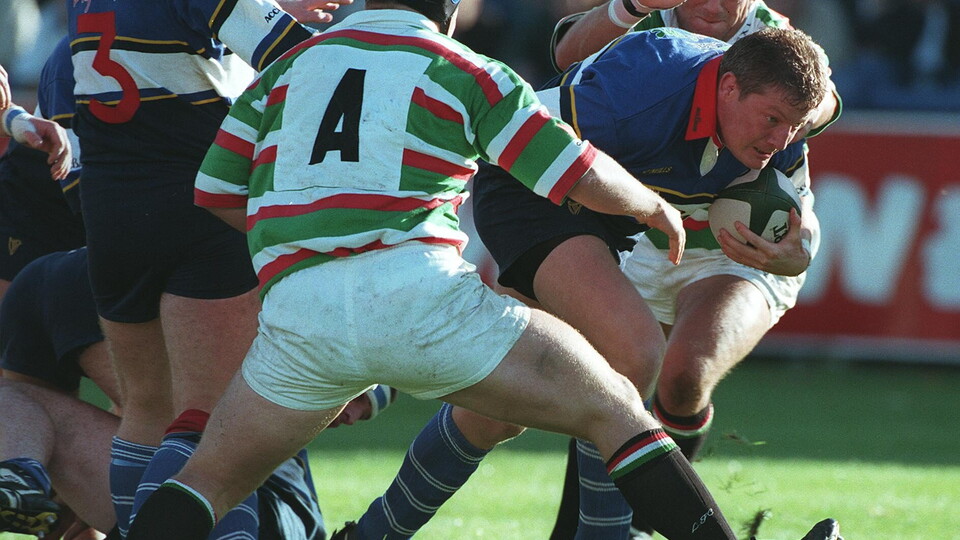
THEN – Steve played more than 20 times for Leinster from 1995-1997.
NOW – He works as Facilities and Events Manager with Leinster, living with his wife Emer in Dun Laoghaire and has two children Lauren (27) and Dylan John (21).
Where: Donnybrook.
When: July 17th, 1997.
There were two dressing rooms at the Old Wesley end of Donnybrook. The spillover from numbers meant Steve Jameson, Shane Byrne and Shane Horgan had to change together alone after another gruelling pre-season session.
“Jamo, are you going to buy me a pint?” asked Shane Byrne.
“No problem, what’s the occasion?” answered Steve.
“It’s my birthday tomorrow.”
Out of the blue, the usually quiet Shane Horgan piped up: “It’s my birthday tomorrow too.”
“What? Guys, you won’t believe this, it’s my birthday as well tomorrow,” added Steve in acknowledgement of an astonishing coincidence.
Steve and Shane Byrne went for a pint and Shane Horgan went his own way, perhaps an indication of the emerging line drawn between the old and the new, the amateur and the professional.
It was Leinster’s struggle to come to terms with the all-in demands of the professional era that delayed the coming of age of a European superpower.

Steve played for Monkstown for three years, losing some friends when he decided to leave for St Mary’s in 1989 where the Cavan man felt right at home.
He played what was then a record 85 consecutive AIL matches. Paul Dean, Declan Fanning, Kevin Potts were some of the club icons that wore that blue shirt.
“I loved playing rugby and I lived for the game for a long time,” he says.
“In those days, club rugby was king so joining St Mary’s was a major step-up for me to play with interprovincial and international players and in doing so testing my ability to play interprovincial rugby” he says.
The introduction of the AIL brought club rugby to a whole new level and with it some brutal battles in Munster.
“Going down to the likes of Young Munster back then was different. Anything went. I enjoyed the confrontation and the challenge,” he says.
Sometimes it got out of hand.
“I recall an occasion whilst captain of St Mary’s when a teammate approached me, carrying an ear injury. He asked me how it looked. The injury resulted in him having to have surgery that evening. Let’s just say he was lucky to keep his ear.”
Steve gave as good as he took. But, there was a line he wasn’t willing to cross.
“When you are in the trenches during some of the tougher games and you look your teammates in the eye, you certainly know who you can trust at the end of the 80 minutes,” he says.
In one particular game, he was on the receiving end of a stamp to the head, going off to get bandaged up. Coming back on, five minutes later, he was at the bottom of another ruck and his head was stood on again.
“You really get a feeling for a man’s character from being in a dark place on a rugby field and, dare I say it, there were more dark places in those days than there are now.
“Don’t get me wrong, I was no angel. I used the slipper a lot and threw and took my share of punches. It was part of the game. You didn’t complain about those things.”
To this day, Steve jokingly says that when he visits Limerick he rarely gets down O’Connell Street without acknowledgement from a stranger about who he was and what he did.
Down there, it is known as respect: “To this day, I am almost always taken back whenever I meet a rugby person, who I played against when the conversation starts off with some memory of me standing on them or punching them.
“It gets me to thinking, ‘I couldn’t have been that bad, could I?.’”
In 1990, Steve declared for Connacht on the basis of his mother coming from Tubbercurry in Sligo, when he wasn’t winning the attention of Leinster’s decision-makers.
“I do have some really great memories from playing with Connacht with the highlight playing against Australia when they were on tour.
“However I never really felt settled there, despite the presence of Noel McCarthy, Tom Clancy, Eric Elwood, Noel Mannion, Mick Fitzgibbon, Simon Geogeghan, etc – great players.
“I suppose the difference was that when I played against Leinster, I was playing against my pals, guys like Kevin Potts, Brian Keane, Declan Fanning, Michael Corcoran, Vinny
Cunningham, clubmates of mine in St Mary’s.
“At Connacht, I was used to driving to training in Athlone on a pitch with floodlights like four candles in the corner of the field. The facilities then are not like they are today.
“You got a bowl of soup and a sandwich and you drove back to Dublin, got up and went to work the next morning and to training with your club the next night.
“You’ve got to love the game to do that,” he says.
After serving Connacht, Ciaran Callen and Jim Glennon made contact to attract Steve and Victor Costello back to Leinster in 1995, making their debuts against South African tourists Griqualand West that summer.
His impact was rewarded with Leinster Player of the Year for the 1996/97 season.
“I was tremendously proud to play for Leinster and some of my happiest rugby memories stem from Leinster performances, none more so than the time we beat Leicester Tigers in the European Cup at Donnybrook in 1997.
“It happened just at the crossover into professionalism. I had just got my first contract for Leinster.
“In those days, Leicester had letters rather than numbers on their backs. Bob Dwyer was their coach. Martin Johnson was my opposite number.
“They came with a star-studded side, Richard Cockerell, Graham Rowntree and Darren Garforth in the front row. Dean Richards was at number eight and out-half Joel Stransky had just dropped the goal to win the 1995 World Cup.
“I remember walking around before the game on a pitch that looked like a billiard table on a beautiful September evening, feeling, ‘wow, how good is this?’
“The place was heaving, packed to the rafters. Anyway, we rose to the occasion and beat Leicester that evening.
“I remember Victor and I decided to skip the formalities and retired to the back bar in Long’s Pub, where Arthur Mayne now stands, something we didn’t fully shake from the amateur era.
A few hours later, one of the lads arrived at the door and sat down.
“Jamo, did you know you got £1,250 for that game tonight?”
“What?”
“Yeah, £1,250 for playing in the European Cup and a win bonus on top of it.”
“That was the moment I fully realised I was a professional rugby player – I would have paid £1,000 to play for Leinster in the game. That is a fact.”
In 1997, Mike Ruddock blew into Leinster like a hurricane, determined to make ruthless professionals out of hard-playing, hard-partying amateurs. It took time.
“Mike realised straight away we hadn’t made the step from amateur to fully professional because we were lacking fitness,” says Steve.
“In pre-season, we trained Monday, Tuesday, Thursday, Friday with ‘optional scrummaging’ on Wednesday which, in reality, we had to go to and a timed 5k run on Saturday morning.
“We were much fitter, much stronger than we had been in previous years.”
Two months later, Steve’s “over-zealous” use of the boot late on caused a penalty which Milan converted for a 23-22 victory in the European Cup at the Pata Stadium in Calvisano.
“Mike didn’t say anything to me personally, but he was livid,” says Steve.
“We still had a couple of pints in the clubhouse after the game. On the bus, he said: ‘everyone, in the foyer, in your running gear at 6 o’clock in the morning. Have a good night! So, we had a few more drinks.”
By 6 o’clock the next morning, he had sourced a cabbage patch and we were ordered to run for 45 minutes.
“Victor (Costello) was struggling at the back of the pack on this horrible paddock and Mike was shouting, ‘Victor! Up the front! Up the front!”
The appropriate athletic response was not forthcoming.
“Victor, that is a £500 fine!”
“Who do I make the cheque out to?” replied Victor.
The sacrifices made to be on the pitch meant sacrifices off it too. Some still sting to this day.
In 1999, a persistent shoulder injury and the grind of playing senior rugby for over 15 years, captaining St Mary’s for three seasons, Steve decided it was time to hang up his boots.
“I must say that after being involved at such a level for so long retiring from the game does come as a shock to the system. You have no training during the week, no match at the weekend. It does take a while to adapt to life after rugby.”
In the meantime, Steve built and sold a business, lived abroad with his family for ten years between Beijing, China and Singapore before returning home to take on the role of Facilities and Events Manager with Leinster Rugby.
“It’s really great to be back in Ireland and I really enjoy working for Leinster rugby and with some exceptional individuals, some I overlapped with during my time playing.
“For example – Leo Cullen, we shared a place on the squad together when Leo was at the beginning of his remarkable rugby career.
“Dave Fagan was our strength and conditioning coach when I was playing and now holds the same position with the Leinster Academy which is fantastic.
“I really admire what Leinster have done. It is such a well-oiled machine. I see how hard they train and how professional it is from top-to-bottom,” he shares.
“In our day, the rewards were there in the friends you made and the camaraderie generated.”
And that is good enough for the man from Ballyjamesduff.