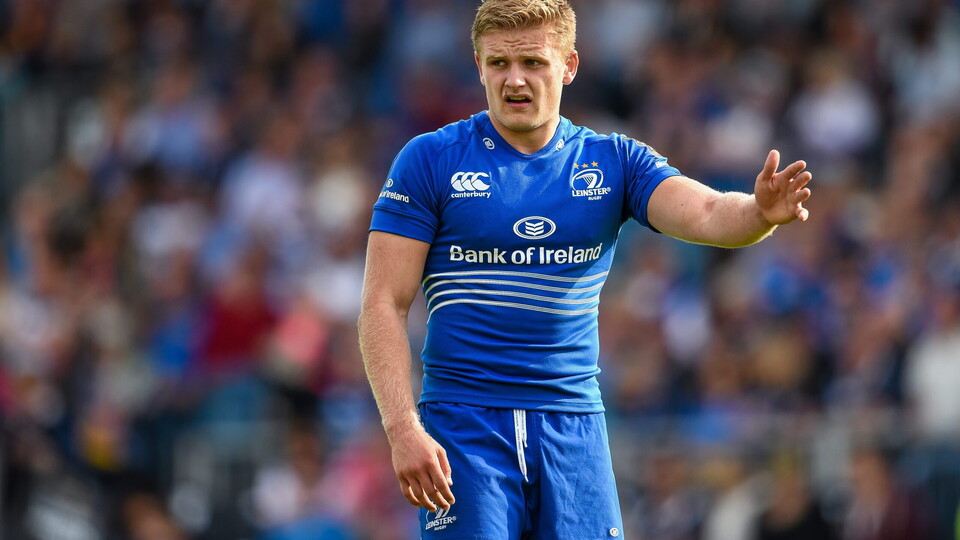
THEN – Steve played four times for Leinster from 2014 to 2016.
NOW – He is living with his girlfriend Roisin in Ballsbridge, working on building his mobile sauna business Fad Saoil Saunas.
Steve Crosbie is a different sort of dude.
St Gerard’s won three Leinster Schools Leagues in a row from 2009 and 2011 and made the Senior Cup semi-finals, beating both Blackrock and Terenure along the way in 2010.
It brought the school and its’ players to the attention of the Leinster decision-makers, Steve and future British & Irish Lions number eight Jack Conan earning entry into the Leinster Academy.
“The pathway is so clear. You can really see the markers you have to hit to make the next step and the step after that.
“I also had Jack (Conan) as a source of information about the benchmarks in the Academy and got completely obsessed with living the dream.”
The process all began when the Crosbies moved from Cork to Dublin: “I would have started my mini’s career in DLSP at 5, usually playing at centre, always playing a year up with my brother Jody’s group.

“When I dropped down to my own age grade, I got more and more responsibility as a ten, being able to read the game, being able to deal better with the pace from my previous experience without realising it.
“I had a bit more time on the ball, organising players, taking control. I grew to absolutely love being the shot-caller, dictating the play because I have good peripheral vision and I loved putting players into gaps.”
It was the beginning of an ascent in the game which took in Leinster and Ireland honours
In fact, Steve used the disappointment of being dropped by Ireland Schools for the FIRA U18 Five Nations Festival in 2011 as a powerful motivating force for the future.
“It wasn’t until I got dropped by Ireland that I really realised how much I wanted this. I made a promise to myself that that would never happen again, especially for the reasons that I lost out on selection.
“Looking back now I think the problem was I was completely focused on getting an Academy contract. I never thought bigger than that.
“I never thought I am going to be the next Johnny Sexton. I never thought I am going to be Leinster’s next out-half,” he concedes.
“That is where I look back and see the first crack in my mentality. I didn’t know my worth or believe in myself as much and really relied on my relationships with coaches in order to feel needed or wanted.”
The diligence required to reshape his body and the knowledge gained from two years in the Sub-Academy and three in the Academy led to four Leinster caps.
“I got obsessed. You get a lot of measurements when you are in the system,” says Steve.
“For example, we did personality tests at Leinster to evaluate the type of personality you had and the type of learner you were.
“The personality test characterised you in a colour system. Blue meant you were very methodical, fact-based. Green was very authoritative and benefited from a solid framework.
“Yellow was very charismatic, relying on feeling and relationships. I was measured as a yellow-orange type. The less I knew the better. It came through in my natural, flowing style of play.
“It was clear as day I was quite different to a lot of the guys,” he says.
“I flourished under Mike Ruddock where there was enough of a framework to work with while enough openness to go off script or play what was in front of you. I thrived in that structure.
“You go into a Joe Schmidt-era where you know exactly what you are doing for three-to-five phases and then you play.
“I struggled a lot with that. Even from the second or third phase, what I perceived as a gap to be exploited was interpreted as going off-script and I would get the head eaten off me.
“As a young fella, I went into my shell, didn’t express myself and was forever asking a coach ‘what exactly do you want me to do here?’ Because that was embedded in me at that time.
“It stymied my game. There were more and more statistics. The pile on of the data started to affect my performance.
“I would focus on making those numbers better as opposed to performing on the pitch.”
He grew up in a creative household where his mother was a singer and his father involved in advertising in the newspaper industry.
Where some rugby players wrap themselves around being a rugby player first and last, it was only ever part of the identification process for Steve.
“I hated being seen as just a rugby player,” he adds.
“I would hate it when I would meet someone for the first time and all they wanted to talk about was Leinster or rugby. It felt inauthentic.
“I was more than just a player. I had interests and hobbies. I wanted my personality to speak way more than the label of being a Leinster player.”
It has caused the 30-year-old to rethink his past and contemplate whether or not the dream was just an illusion.
“There is always an internal voice that asks ‘was rugby ever for me?’ I thought it was my destiny. I lived the dream. When I got my first cap, it was unbelievable. I was delighted – especially at that moment. But was it worth all of the sacrifice even when things were going my way?
“But, when your hobby becomes your job you see it differently, more distractions started to come my way, the sacrifice of missing family occasions and friends’ birthdays began to weigh on me.
“If you want to be the best of the best, you have to do those things,” he shares.
“There was an 18-month period when I did dedicate myself completely to that lifestyle when playing with the Ireland U20s and just every decision I made every day was about me.
“In that time, I broke up with my girlfriend, my relationship with my brother and family suffered because If it wasn’t anything to do with rugby I didn’t care.”
After travelling to play for Wanganui in New Zealand, Steve was very specific about what he wanted to achieve when coming back home to accept a senior contract with Munster.
“I wrote out SMART goals, a framework taught to me by IRUPA, but sport, as I have come to terms with, also relies on timing.
“God bless him, but Anthony Foley passed away two weeks after signing me for Munster, so I never really settled down there knowing I only had a three-month contract.
“I have had to do a lot of work on myself mentally, digging deep, searching for answers. The biggest fear for any rugby player is ‘what will I do now?’
“I am and will be forever grateful for the support I have had from my mum, dad, brother, girlfriend, my best mates and anyone I was lucky enough to ever work with.
“Being surrounded by the best of the best drives you beyond places you thought were ever imaginable. High Performing environments made me be at my best and expect more from myself.
“The work done both on and off the field to develop a whole rounded individual is why I still and always will love rugby “.
The questions that swirled around his head when Steve was playing professional rugby made it easier to leave the game behind. Offers overseas were not as attractive as they once may have been.
The stay at Leinster was followed by short stints in Wanganui, New Zealand and Munster before 18 months at Connacht and retirement at just 25.
Now, Steve has found his mojo as the Director of Fad Saoil Saunas, Ireland’s first professional mobile sauna service at seaside locations promoting thermoregulation therapies.
“I now use the fear I felt in rugby. Whenever I feel fear on the entrepreneurial path I am on, I interpret the feeling of terror as proof that I am doing something right.
“I push through. I force myself to embrace the terror, ‘embrace the unknown.’ That is a mantra of business, a mantra for life really.”
The idea for ‘Fad Saoil’ evolved over time.
“I have been a sea swimmer for most of my life and it drove me nuts that no one would come with me,” he shares.
He experienced many different professional environments and realised the benefits of going from one extreme temperature to another, as professional athletes do so often from a recovery perspective.
He thought that this should be rolled out to the general public and that this practice should be experienced by everyone.
“Finland, for example, has roughly the same population as Ireland. There are over 3.5million public saunas in the country.
“‘Fad Saoil’ means long life or longevity in Irish. The business is aimed at anybody who is searching for more out of their lives.”
This experience is a fun, healthy, unique lifestyle that can have astronomical health benefits.
“It was established in 2019 to communicate, educate and inspire people about the health benefits of sauna use and Irish Sea Swimming in rain, hail or snow.”
It is his passion. He didn’t have to think twice to dive right in.
“I got to live one dream, why can’t I live another one?”