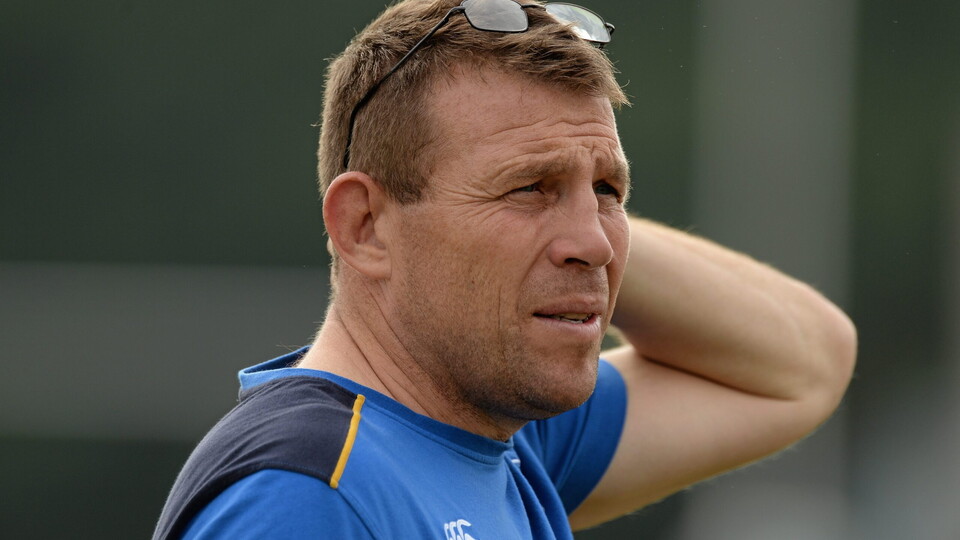
THEN – Kelvin played for Leinster between 1989 and 1995.
NOW – The Head of 5th year at St Michael’s College and his wife Deirdre live in Glenageary. They have three children Jennifer (30), Kelvin (28) and Bobby (24).
Munster by birth. Leinster by the grace of God.
Kelvin Leahy was born in Cork and was educated at Crescent College Comprehensive in Limerick where he was captain of the 1983 Munster Schools Senior Cup triumph.
In fact, the 57-year-old made his way to Kilkee, in West Clare, recently to attend the 40-year commemoration of that glorious day.
“It was such a joy. Everyone is still fit and well,” he said.
A Munster man through and through. So you would think.
In 1984, Kelvin came to the capital city to join his brother at Wanderers and the attraction was as good as immediate.
In September of the same year, the first experience of senior rugby for Wanderers came alongside Ireland internationals Robbie McGrath, Mick Fitzpatrick, Ian Burns and Jerry Holland against English club Waterloo in Lansdowne Road.

“Really, straight off, I felt Dublin was the place for me and Leinster would be my preferred choice rather than travelling up and down long-term.”
In 1984, Kelvin was invited to join the Leinster U19s and U20s in the same year by coaches Eddie Wigglesworth and Johnny Molony, also captaining the U20 Combined Provinces, now known as the Ireland U20s, for two years in 1984 and 1985.
“I loved it from the get-go at Leinster. But, I went through a couple of years of injury issues with my shoulder and knee, which meant I missed out.”
The entry into provincial rugby was delayed until 1989 which wasn’t unusual in the amateur era, especially for a forward.
“After the injuries, I wasn’t sure whether I would be able to continue playing because they were both joint problems. They were giving me a lot of recurring problems. Then, they started to settle down.
“Leinster were not the force they are now at the time and I suspect they sent out selectors to have a look for new players. I think the coach Roly Meates rang me and asked me to come to training. And that was it.”
By the time he made the step up, Kelvin had already been playing with Ireland internationals Ronan Kearney, Paddy Kenny and Phil Matthews at Wanderers.
“It was a brilliant environment for learning,” he says.
“My first game for Leinster was in late 1989 against Connacht. I knew it was a way to impress for the match against New Zealand later that month.
“It worked out for me. I stayed in to play against the All Blacks. That was the first taste of ‘big boys’ rugby.”
It came just one week before Willie Anderson’s infamous march of his Ireland teammates to the halfway line during the Haka.
The Whetton brothers Gary and Alan, Zinzan Brooke and future British & Irish Lions coach Warren Gatland were all playing against Leinster.
“In 1989, we played New Zealand when they were world champions and, in 1992, we played Australia when they were world champions.
“That was my chance to play against the Wallaby loose forward Willie Ofahengaue and out-half Michael Lynagh. I mean you were playing against your heroes.
“It is such a shame that those types of games are gone in the professional era. Now, they may come back because of the experience of Ireland playing the Maori in New Zealand last summer.
“I also played for Ireland against the All Blacks in 1992, unfortunately breaking my fibula in the middle of an epic test match, losing 24-21 in Carisbrook.
“Those were amazing experiences,” he adds.
“I suppose what you noticed were the speed of the game, the sensation of the sheer weight of the hits and their body height.”
It is those high-profile tour tests that stick in the memory rather than the interprovincial matches.
“In terms of Leinster, the experience at the time was fantastic, playing against the world champions in 1989 and 1992 as well as going up against Ulster, the dominant province back then during the 80s and early 90s.”
In 1991, Kelvin was captain of Leinster for most of the season, following on from a stint in the role for Wanderers.
“I had captained every team all the way up along, bar the Irish Schools, including captaining Ireland for the midweek games in New Zealand.”
It was in the blood. His father Mick Leahy was capped by Ireland in 1964 and captained Highfield when they last won the Munster Senior Cup in 1968.
“He would have had a big influence over my captaincy. He passed on the importance of preparation.
“A captain needs to prepare for the dressing room, words on the field and tactically. He instilled in me that you criticised the group, never the individual.”
In 1995, Kelvin was called back up by Leinster for one match after a few years in the wilderness, losing out to Connacht at The Sportsground.
“I needed to be as fit and strong as possible. I wasn’t the most talented player in the world. I didn’t have the best skills. When I wasn’t, I struggled a little bit.
“I was delighted to play because my brothers Colin and Shane were playing for Connacht. But, at that point in my career, the injuries had taken a toll on my strength and fitness.
“It was my one and only experience as a professional. I distinctly remember getting a cheque sometime after the match for 500 pounds.”
It is the characters that live as long in the memory as the matches when it comes to recalling those days in blue.
“It was serious and it was fun. Gary Halpin was just so much fun. He was the life and soul in a very positive way. Nick Popplewell was a great person. Peter Purcell from Lansdowne was another.”
In the early 2000s, Kelvin made the life-changing decision to switch careers to satisfy a long-time interest.
He left fund management to pursue a Higher Diploma at Trinity and secured a job in St Michael’s College where he has been for 15 years and is currently Head of 5th Year.
In 2012, Kelvin was head coach, assisted by Bernard Jackman and Shane Hunt, when St Michael’s won the Senior Cup for the second time with future Ireland internationals Dan Leavy, Ross Byrne, Ross Molony, Josh Murphy, Cian Kelleher and Rory O’Loughlin.
“I became a teacher at the ripe old age of 42,” he shares.
Why? “I had always thought about it. It is the ability to work with young people, to have the privilege to guide them, push them, encourage them, to be a role model for them.
“I love it, absolutely love it. It is a great joy.”