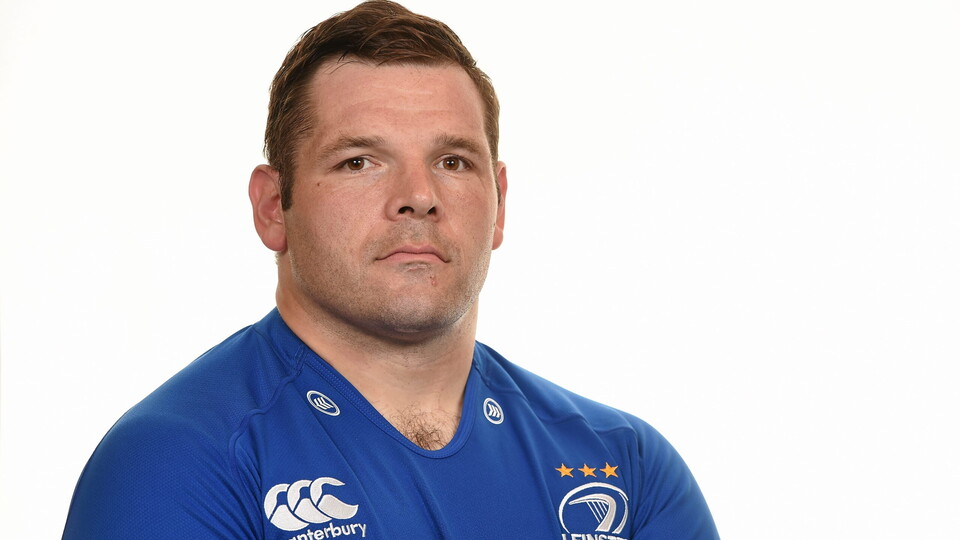
THEN – Mike earned 151 caps for Leinster Rugby and 61 caps for Ireland in a 12-year career.
NOW – He is Sales Director for Amdocs, living with his wife Kimberlee and children Kevin (12) and Chloe (9) in Churchtown.
Mike Ross had to leave home to come back and become a champion.
The latest of bloomers only became a professional at the age of 26 and made his international debut at 29.
It was those pre-professional years that fuelled the Corkman to overcome his doubts, and those of others, on his rise to the top of the game.
In 2006, he was deemed surplus to requirements by his native Munster and appeared stalled in a career ‘cul de sac,’ on and off the field.
“I had secured a degree in Plant and Microbial Biotechnology from UCC in 2003. I spent three years working in a laboratory for Enfer.
“To be honest, it was not for me. I had not enjoyed it at all,” he says, candidly.
“I was working in a food lab, testing for different bacteria. While it was relevant to my degree, the work was repetitive and tedious. I had no interest in going back to that when Munster didn’t work out.

In April 2006, he was told there would be no contract available. The love of the game convinced Mike to look for an agent to open up the possibility of playing professional rugby outside Ireland.
That is when Justin Paige entered the picture as the agent to Dean Richards, the Harlequins’ head coach. This connection opened the door ever so slightly.
“I got two trial matches for the Harlequins’ seconds team. I did enough to be offered a three-month training contract in the summer of 2006,” he says.
The short-term nibbles at long-term security reminded Mike that there would be no easy way to a place at the professional table.
“It was a great focus for the mind. It was one last chance saloon after the other. That summer, I lost twelve kilos in three months. It was the making of me as a player”.
He was able to nail down the number three shirt at ‘Quins for three seasons before Leinster showed an interest.
At that stage, it was far from a foregone conclusion that Mike would return to Ireland.
“I was starting for Harlequins. I had made the Premiership Team of the Season when I met (Michael) Cheika in February of 2009.
“At the time, Leinster had CJ van der Linde and Stan Wright (pictured above). I wasn’t sure where the room for me was in that equation”.
There were no promises made either.
“I knew if I wanted to play international rugby, I had to come home and start for a province”.
Ultimately, Mike decided to join Leinster as a means of playing for Ireland. Simple as that.
From the outside, he didn’t look like the perfect fit for the way Leinster played. But, Cheika had driven a new attitude to forward play and Joe Schmidt came in to add to it.
“When I got there, the scrum was viewed as a way of restarting the game whereas the culture in The Premiership was that it was a test of manhood.
“It was all about physical domination and that started with domination in the scrum and domination in the maul. They were two completely different styles of play.
“I tried to bring some of that Premiership mentality to Leinster. It took a while. But, the perception there had changed.
“They knew if they wanted to compete with the huge French and English clubs in Europe, you had to have a solid scrum”.
He could never have predicted the glory years to follow under Schmidt, winning the Heineken Cup in 2011 and 2012 as well as the Challenge Cup in 2013 and the PRO12 League in 2013 and 2014. It all led to the green shirt.
“It was a childhood dream come true to pull on the Irish jersey. I made my debut on a tour of North America in 2009,” he says.
Mike had come a long way from Munster outcast to Leinster and Ireland stalwart. Then, his rugby career ended in 2017,
“I have spent the last six years being deeply uncomfortable,” concedes Mike.
“It has been difficult. When you leave the rugby bubble behind, all your friends are still there.
“I probably missed the craic the most. You are an eternal 15-year-old in that dressing-room environment.
“For want of a better word, you are doing something that is ‘cool.’ When you meet someone and they ask you what you do, they often remark how interesting it is to them.
“It becomes a large part of your identity, pretty quickly”.
The fear of what was next didn’t hold quite the same trepidation as those who had been professionals all their working lives.
“It wasn’t a great unknown for me. I knew what a working life was. It encouraged me to stay in rugby as long as possible,” he laughs.
“All of a sudden, you are moving into a new area where everyone around you has 15 years of experience over you.
“You suffer from a degree of imposter syndrome. But, the one thing rugby teaches you is the resilience to keep showing up. That takes you a long way in the real world.
“There is also self-awareness. In sport, you are always intensely critiquing yourself and, since retiring from rugby, I have met quite a number of people with zero self-awareness.
“They just don’t understand how others see them”.
The previous laboratory work experience meant Mike knew what he didn’t want to do. He just had to figure out what he wanted to do.
“I met a recruiter in March 2017. It was suggested to me that my interest in and knowledge of tech as well as my profile made sales a possibility, eventually leading to a position as Sales Director for Wizuda”.
When the pandemic spread, Mike’s job was no more as unemployment spiked and the prospect of a new opportunity looked bleak for six months.
A tax rebate from his rugby career mitigated the pressure to provide for his wife Kimberlee and children Kevin (12) and Chloe (9).
“That allowed me to sleep at night,” Mike admits.
“I knew that I was moving into a sales process and I had to sell myself. You need a pipeline of opportunities in sales. I have always been a massive believer in the power of networking.
“I am a greedy bugger, so I had two mentors. One of them, Michael Ryan, opened the door to getting my first job.
“The other, Joe Hogan, paved the way for an interview for my current job as a Sales Director for Amdocs which is a better job in a bigger company with more resources.
“I am learning the ins and outs of a large multi-national company as another step in my business education.
“Sales can be quite an enjoyable profession as at the heart of it it’s about listening to and helping to solve someone’s problem.
“I’ve always liked that challenge”.