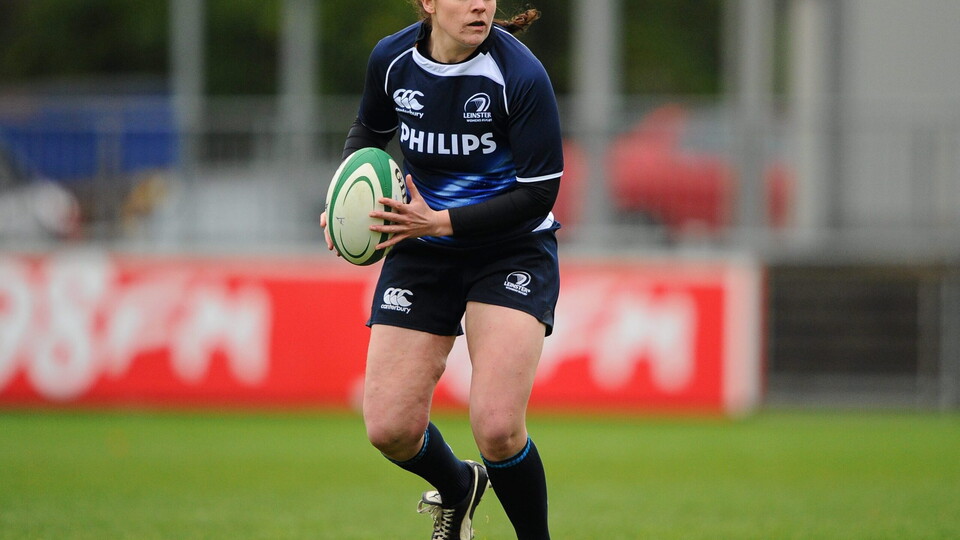
THEN - The 2013 Grand Slam captain earned 85 caps for Ireland over twelve seasons (2003-2014).
NOW - Fiona is a teacher at Holy Faith, Clontarf, a RTÉ rugby analyst and sports consultant, living with partner Colin and her son Harry (2).
Fiona Coghlan is a woman of our time.
The physical education teacher works in her ‘alma mater’ Holy Faith, Clontarf, while also sharing her expertise as a RTÉ rugby analyst and a sports consultant for Navy Blue Sports.
“I grew up right beside Clontarf Rugby Club. I would have spent a lot of time socialising there, including holding my 18th birthday at the club.

“In all that time, I had never seen a woman playing rugby. I didn’t even know they played rugby,” admits Fiona.
“I didn’t even know it was a thing until I went to do Physical Education at the University of Limerick in 2000.
“I just signed up for everything in Freshers Week at UL. I went to the first session and didn’t enjoy it at all.
“I was in with the forwards doing a lot of set-piece work. I came away thinking, ‘That’s not for me.
“You don’t even sweat playing this sport’”.
Two weeks later, Fiona received an email asking if she would play in a match because UL was struggling for numbers for a 10-a-side game.
As it turned out, it was Dublin City University who could not field a full team and Fiona played her first game of rugby for DCU.
“That was all it took. After that first game, I was hooked. I didn’t have a clue what I was doing. I just ran until someone stopped me. There was just more freedom to it”.
Fiona benefitted from the expertise of coach Ian Costello, Munster’s current Head of Rugby Operations and a crew of like-minded women.
UL Bohemians won the All-Ireland League in the first season, going on to completely dominate the national stage with 11 titles between 2001 and 2013, Lynne Cantwell and Fiona progressing to Grand Slam glory in 2013.
“Back then, I never found the Interpros a step up from the club because the succession planning and the standard of coaching was very targeted at UL Bohs,” she says.
“The season was disjointed. It would be Interpros, club and international. In my eyes, the club game was number one over the Interpros because we trained and played more regularly”.
The Interpros were still a shop window for Ireland as the national coaches would attend those games.
Fiona had to wait until 2005 when Leinster, captained by Caroline Mahon and coached by Shane McEntee, finally broke through as Inter-provincial champions.
“There was precious little coverage or even knowledge of it,” concedes Fiona.
“Women hadn’t seen women play the game. They didn’t know it was an option for them, so they didn’t explore it.
“It didn’t change all that much until the Grand Slam in 2013. Even then, there was hardly any notice taken of the first win in Wales (12-10). No one spoke about it.
“There was no real profile. Only the people who knew us or were linked to us would have been at those games”.
Of course, there is nothing like an Irish underdog rising up to stun ‘the auld enemy’ to pique the interest of the general public.
“It was only when we beat England so significantly (25-0) out in Ashbourne that the bandwagon started to roll. People began to come on board for the journey.
“Then, the real explosion in interest happened when we were put on television for the first time for the decider against Italy on St Patrick’s Day.”
In many ways, Women’s rugby has been trying to revive those magical moments of 2013 and the 2014 World Cup.
The advent of professionalism in Ireland came too late for Fiona.
“I would have loved the opportunity to play professionally, to see how far I could push myself, in terms of the gains I could have made.
“The closest I got to that was the lead-in to the 2014 World Cup. We had the right coaches, We had the right management.
“We were on a brilliant summer programme. I was on my holiday from teaching. I was able to do extra analysis and have the rest and recovery time from sessions.”
In 2014, Fiona decided to retire from rugby after a World Cup in which they became the first Irish team to beat New Zealand on their way to the semi-final.
There was one more hit out, captaining the Barbarians against Munster at Thomond Park in 2017.
The post-playing career has evolved into a role in RTÉ’s analysis of rugby as well as consultancy work for Navy Blue Sports.
“I started out with RTÉ in the Women’s game and it progressed into the Men’s game in 2017. I feel honoured to be able to sit in that seat and talk about rugby.
“But, it is certainly a lot more work than I ever thought it would be. After playing, I think it is the next best thing,” she says.
The game has given Fiona an outlet to extend her working career and so much more.
“Rugby has given me the relationships I have forged with people from every walk of life.
“The Grand Slam is not about the medal - I don’t know where that is - it is about the people you won it with.
“The game also demands clear communication in pressurised situations to get the right outcome and it teaches you resilience, how to deal with things that don’t go your way.
“I would be big on that at school with the kids, learning how to deal with failing and how to grow from it.
“Trust me, in the early days, we often failed, in terms of our results. That didn’t get in the way of learning to be better.
“Professionalism had to happen. I was surprised at how quickly it did.”
Fiona has returned to her ‘alma mater, Holy Faith in Clontarf to spread the gospel of rugby.
“I have junior and senior teams in the embryonic stages. I see such talented players. If they could commit to rugby, they could go so far.
“There are just so many other activities and other sports available to girls now, especially the GAA”.
The game has come a long way.
“I just look at my local club. Clontarf has a girls’ minis programme, U14s, U16s, U18s, so that girls can step to every level. It can be their sport as opposed to just picking it up in college.
“I have to say Leinster have been brilliant at encouraging schools to start playing rugby. All of our first years do Touch Rugby as part of the P.E. programme.
“Then, Leinster run Touch Rugby blitzes where we take the girls on a day out to play at their level whether it is 7-a-side, 10-a–side or 15-a-side.
“There are so many more opportunities to get them in, to get them playing as early and often as possible.
“It gives the pathways to improve and move up the levels to play in school, in the clubs at the area level for Metro, for Leinster and for Ireland.
“I tell the kids there are very few professional sports in Ireland for women and rugby is actually one of them.
“Besides that, there is the attraction of the 7s circuit and the possibility of playing at the Olympics.
“It is a really exciting sport to play for the opportunities it brings.”