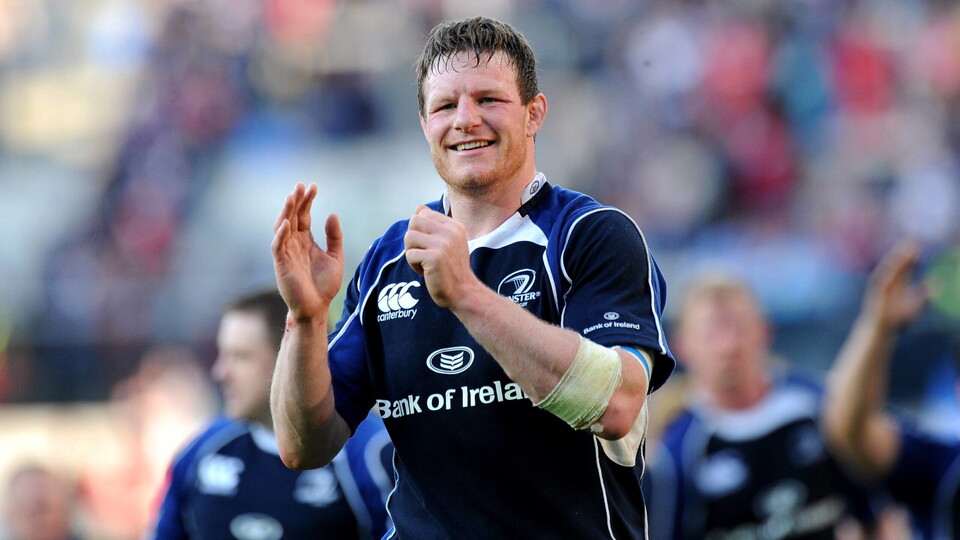
THEN - Malcolm played for London Irish and Leinster, earning 92 caps for Ireland in a career spanning 1995 to 2010.
NOW - He works as an Orthopaedic specialist for Tekno Surgical, married to Stephanie with three sons Cian (12) and twins Patrick and Dylan (10).
Love at first sight.
It is just as stunning in rugby as it is in matters of the heart.
There are just a few players this grey journalist can recall seeing for the first time. The venue. The action. The impact. The man.
Sean O’Brien at Donnybrook in 2004. Denis Leamy at an Irish Schools’ trial at Blackrock College in 2000. Gordon D’Arcy in the 1998 Leinster Schools Senior Cup. Malcolm O’Kelly in 1997.
They all had something different.
Malcolm moved with the grace of a gazelle as a long-striding, light-framed lock for London Irish, galloping around the plains of the English Courage League Division One.

This was back in the days when second-row forwards were built for battle in the trenches, not balletic movement in the open field.
The game turned professional after the World Cup in 1995. A revolution was afoot. England was the place to be.
London Irish coach Clive Woodward came across the Irish Sea to recruit as many Irish players as possible for the Sunbury club.
“I met Clive in The Gresham for a chat. He was very enthusiastic, had great ambition and had a master plan for the future of London Irish,” says Malcolm.
He joined Kieran Dawson, Jeremy Davidson, Niall Woods, David Humphreys and others as part of an Irish invasion at the dawn of a super-exciting time in the game.
The three seasons at Sunbury uncovered a rare talent coveted by Bath and Castres Olympique when the time came for a change.
But, Leinster Manager Jim Glennon had always stayed in touch and when the IRFU became serious about bringing back Ireland’s best players. Malcolm was approached.
“The first year back, Leinster’s season hadn’t been fully populated with games between the Interpros and the inaugural Celtic League.
“We filled the rest of the season with our clubs. It turned out to be a successful year, winning the Celtic League final against Munster and then winning the AIL against Lansdowne for St Mary’s,” remembers Malcolm.
“When I started out with Leinster, the facilities were non-existent. We worked out of old shipping containers in the grounds of Old Belvedere. The weights room was cold and damp. Our dressing rooms were the boots of our cars.
“It wasn’t until we moved to Riverview in Clonskeagh that the importance of a team changing room became apparent for team banter spirit and morale.
“There was a lot expected from Leinster and we expected a lot from each other and we delivered in only fits and bursts as a frustrated group
“In hindsight, it is no surprise we never achieved what we could have in those early years,” he says.
“There was the first-15 and then the ‘bag holders’. Some played every minute while other talented players had little or no game time, becoming disillusioned and dispirited. Many with little opportunity moved on and took playing contracts elsewhere
“It was a challenging time. We had a lot of coaching changes and a lot of players coming in and out.
“A lot of new beginnings and false dawns, team meetings, goal-settings and soul-searching. Great highs and cutting lows.
“It is only now when you see how consistent Leinster has become that you fully realise the importance of a squad that is utilised to its full capacity.
“It is perhaps not surprising that Leo Cullen, who experienced these challenges in the early days first-hand, has spearheaded this development.”
Malcolm accumulated a stellar career, despite dealing regularly with injuries.
“Six or seven operations on prolonged groin problems prevented me from being at my best for a couple of seasons into the Cheika reign. This was also when I lost my starting position in Ireland,” he admits.
“I accepted this as the competition in the row was like never before. You had to be at 100%.
“At times, you don’t miss games. You have to manage and develop a program to get you from game to game and from season to season because as any pro will tell you, you are never 100% going into a game.
“I think backroom teams have become more aware of this. They help to manage players through seasons more effectively today.
“In the latter years, Steve “Sidwell” Smith began a prehab program the team engaged with that he developed and rolled out into a startup Kitman Labs.”
The public perception of the engineering graduate from Trinity College was of being incredibly laid back.
“I have to admit I got on some coaches' nerves. I was a little absent-minded and got a reputation for being late which although I tried to shake I kept compounding by showing up late again” he chuckled.
“By the end of my career, it became a great source of entertainment to the Leinster squad when I would fall foul of the standards I tried to set.”
At that stage, Michael Cheika was bringing about a radical evolution of standards.
“He treated people differently,” shares Malcolm.
“Not everyone was seen as a round peg for a round hole. He was inspiring. He drove standards by his work ethic. He empowered players to be leaders, regardless of their age, Johnny (Sexton) being one.
“These last couple of years under Cheika were, arguably, my fondest. Although I was no longer at my peak in terms of athleticism, I was more effective, loving my rugby, injury-free, and playing in a determined squad with a realistic goal of winning the Heineken Cup. Then, of course, we did it”.
Leinster’s transformation was complete when crossing the threshold from pretenders to champions in 2009.
“Initially, it was a feeling of incredible relief, soon followed by a real sense of achievement from our endeavours for our fellow squad mates and family and the greater Leinster family.
“There were a lot of guys from my vintage, like Denis (Hickie), Victor (Costello) Keith (Gleeson) and many more who paved the way to this achievement who were no longer involved, so I felt a great satisfaction to have hung in there”.
By the time Malcolm concluded his rugby career in 2010, he had amassed 178 caps for Leinster and 92 Ireland caps and made it onto two British & Irish Lions tours in 2001 and 2005.
In 2010, Malcolm walked away from rugby and towards a more normal civilian life
“I took a year away which included extended travel. I took the opportunity to look into a number of potential career paths. I had always envisaged working as an engineer and I really wanted to get involved in something technical, something I could be an expert in.
“I explored various fields including the medical field. I approached my good pal Niall Hogan, an orthopaedic surgeon, who helped pave the way for me to get involved in orthopaedics.
“I became completely absorbed in the field of medical devices and was able to secure a role in Tekno Surgical. I have been there ever since. It is hard for me to fathom that I am nearly as long in the medical devices industry as I was in professional rugby
“My role is diverse. There is a significant clinical aspect to it, a teaching and training aspect, a management and a business development aspect.
“I keep on top of advances in techniques and new product developments for my customers
“If a patient has to have a knee or a hip replacement, I am there for the surgeon and the nursing staff in the theatre as an expert in the device being implanted and there as a technical reference for the capabilities of the product”.
The years of high performance in rugby-built character from the many team highs and lows that littered 15 years of professional rugby.
“I have taken resilience and adaptability from rugby into the workplace,” he says.
“You have to be prepared to put the head down and graft, especially in the early years, when everything is new. I feel very fortunate to have fallen into an exciting space.
“I certainly miss playing, but am privileged to be working in my current environment,” he says.
“I am a passionate Leinster’s fan but am happy to be able to set it aside and enjoy family life balance with my wife and three amazing boys - even having time for a little golf”.