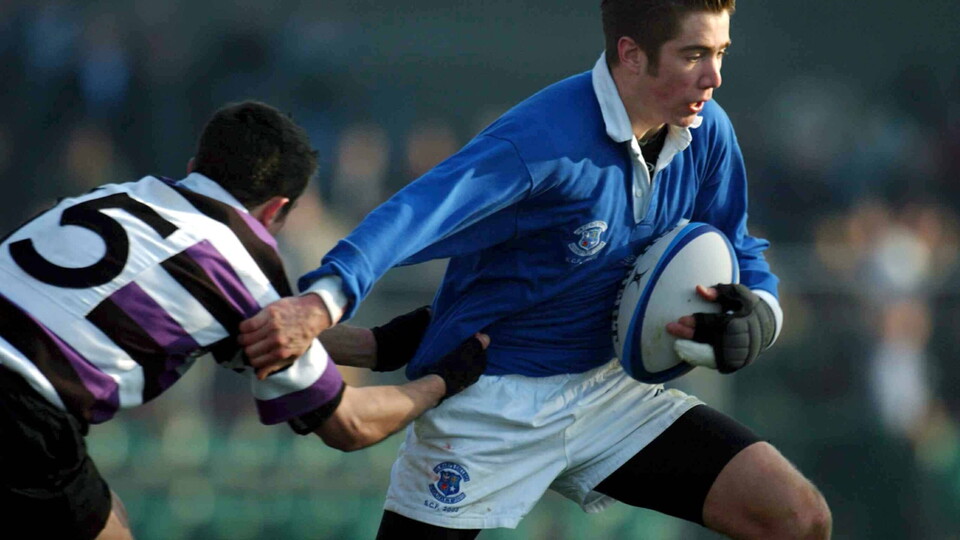
THEN - He played for St Mary’s College for ten seasons in the Energia All-Ireland League.
NOW - Philip is the Founder and Chief Executive of PushMe, living in London with his wife Isabel and daughter Harper (1).
Philip Brophy knew there was something up when he couldn’t get out of bed on his left-hand side.
In 2015, for a couple of weeks, he couldn’t generate any power in his elbow and he had to roll out of bed on the other side.
While this was happening, the versatile St Mary’s College back was still training Tuesdays and Thursdays in the hope of playing at the weekend.
He was on the way back from a season of premature retirement in the middle of playing in the Leinster Senior Cup as preparation for the Autumn onslaught of the All-Ireland League.
“Eventually, the physio advised me to get a scan when he couldn’t figure out what was wrong,” says Philip.
He made his way to The Mater Private where spinal surgeon Ashley Poynton ordered a scan to evaluate his condition.
“I remember the day well. I got a call within 30 minutes of the scan telling me not to do anything. I had a ruptured disc in my neck.
“The message I was given was that I was lucky I hadn’t received another bang on it. In hindsight, I am grateful that it didn’t turn into anything more serious.
“The instructions were clear. Don’t exert yourself. Don’t go for a run. Certainly, don’t play rugby. That was that.
“I was presented with scary statistics that included the chance of stroke from an operation. I decided for rest and rehabilitation and retirement”.

In 2004/2005, Steve Hennessy and player/coach Peter Smyth succeeded Brent Pope as St Mary’s College head coach.
The club had dipped from AIL champions in 2000 to relegation four seasons later. It was time for a change.
The desire to start over meant the careful blooding of younger players like Paul Nash, Rob Smyth and Philip Brophy on the way to the sweet taste of promotion from Division 2 by the end of the season.
A baptism of fire awaited in Philip’s first experience of Division 1, an old-fashioned 42-13 humiliation by Shannon on October 15th 2005.
It was a sobering experience for the rookie inside centre, despite having Jonathan Sexton at out-half and John McWeeney at 13.
“I always kept that game in my head. It never left me. It was the standard of what it took to win an AIL title.”
It was difficult to strike a balance between playing serious rugby and building a career as an amateur playing with the commitment of a professional.
“It is a challenge. You do miss out on social events and occasions,” he says.
“But, on the flip side, it does help as well. It gives you a lot of discipline. It causes you to think about how you can show leadership in both environments.
“You are very fit and, mentally, you are sharp,” he says.
“Whether it was on the training paddock or the main pitch at Templeville Road, that was my paradise,” he says.
“It didn’t matter what was going on in your personal life, your family life or your work life.
“That was 80 or 90 minutes when you could blow off steam, let out your aggression, work on your game surrounded by your friends and teammates.
“In 2012, winning the All-Ireland League was the most amazing feeling. It allowed me to take in the journey we had made in seven years.”
When the precious moment arrived, it took the intervention of Mark Sexton’s late converted try against Young Munster to turn back the clock to the club’s only other title in 2000.
The next season, St Mary’s tumbled down to eighth to convince Philip the time was right to hang up his boots.
“I had had enough years of average finishes on the table. I don’t know if it would have been harder going out on top. Maybe, that is why I played on after 2012,” he shares.
In 2013/2014, he spent one season as a coach and was tempted back into playing when he didn’t enjoy the experience.
Just weeks into the 2015/2016 season, Philip’s playing career was compromised by the ruptured disc and his future was mapped out by Mr Poynton.
The “paradise” Philip had known in rugby was hard to find in a suit and tie, forcing the 31-year-old to come to terms with his life at that point.
“There is a massive vacuum when you have to give up something you put so much time into.
“It is the training. It is being fit and strong. It is playing in front of a crowd. It is all the other stuff that goes with being part of a sports team. That is what I really missed. Still do.
“For me, I was good at rugby. I had a good acumen when it came to the game. In business, I was just like anyone else. I was no one.
“You lose your identity for something you have been doing for 25 years. That is difficult to deal with”.
In 2015, Philip had to face up to the twin prospect of dealing with a serious injury and the end of his rugby career. All at once.
“I had wanted to continue playing Junior rugby. That wasn’t going to happen. It was pretty devastating because rugby was such a big part of my identity”.
An education background in chemistry led to the medical diagnostic sector for seven years, leading to a Masters in Management at the Smurfit School of Business.
It was followed by seven more years working at Phonovation, a mobile communications company, and a Business and Executive Coaching course at Smurfit.
All the while, there was a simmering ambition to be his own boss. He wanted to do life his way.
Two years ago, Philip launched a digital coaching platform called PushMe, primarily helping companies to retain their top talent.
“Disengagement and resignations have a major impact on a company’s bottom line. We look to help in that space.
“Our platform is built on a very simple principle - an employee becomes disengaged or leaves his/her company because he/she has a problem that hasn’t been solved.
“It could be an unmanageable workload, a difficult colleague or a lack of career progression,” says Philip.
“We empower people to find solutions to the problems they face every day in their role using a combination of one-to-one coaching, personalised support and bite-sized content from the latest behavioural and performance science”.