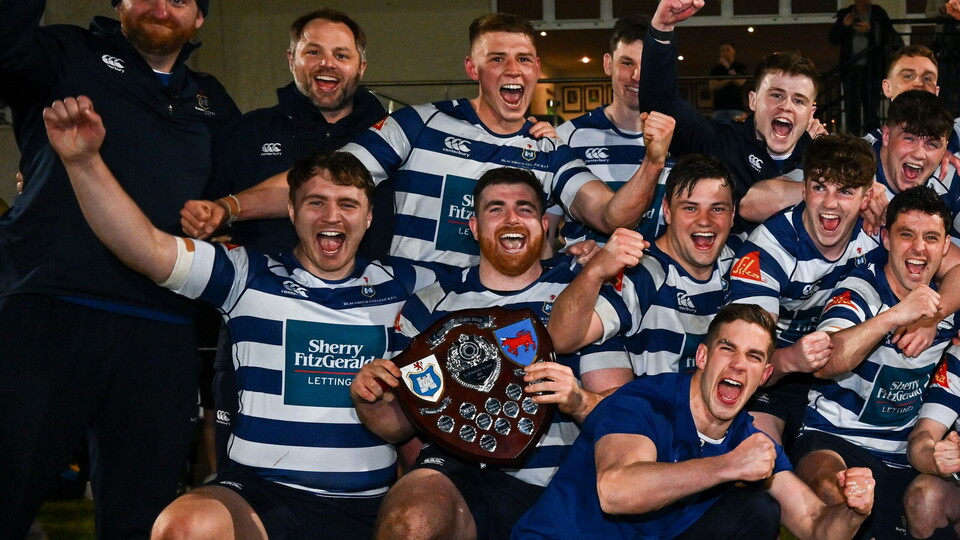
Emmet Burns has a gift - a smile that never leaves.
It stands in line with a naturally positive demeanour, despite failing to win a Leinster Schools Senior Cup with Blackrock College in 2015 and 2016.
The outward expression of a man in love with life has been prodded, needled, operated on and, just plain, tested to the limit.
After four months of having itchy skin, Emmet woke up one morning with a lump above his collarbone.
A chest X-ray was ordered at St Michael’s Hospital in Dun Laoghaire. Two hours later, driving home from the gym, Emmet received a call from his GP.
“You might want to pull over,” said the doctor.
Two minutes from home, he pulled to the curb on Killiney Hill Road.
“It looks like you have swollen lymph nodes around your chest. It could be anything from a variety of infections to lymphoma. But, you should go to the emergency room at the hospital straight away”.
That was when it dawned on Emmet that there could be something seriously wrong.
Mum Cathy took him to the hospital. Dad Paul met them there. They sat for six hours. He was seen. There were no beds. He was advised to come back in the morning.
A sleepless night was spent at home. Emmet was convinced it was an infection related to a recent shoulder surgery. It made sense.

A CT scan, a type of X-ray that gives a very accurate picture of the location and size of any tumours, an ECG, a simple, non-invasive test that records the electrical activity of the heart and other multiple tests were carried out from Monday to Friday.
He was advised a biopsy would be needed to examine suspicious tissue.
Emmet needed someone to be with him. He organised to meet his mum. She disregarded the Covid protocols to be by his side.
At this point, Emmet and Cathy had had enough of waiting.
“What are the chances of this being lymphoma?” she asked the consultant.
“95%”.
Emmet was silent. He had shut down. Mum took over.
The consultant was reassuring.
“It is going to be a roller-coaster ride. You don’t need to do much. You need to strap-in and let other people take care of you.
“Close to 100% of people who get this recover from it”.
The next morning, Emmet was wheeled in for surgery. It was the same day the HSE (Health Service Executive) system got hacked.
“They couldn’t find my records. They didn’t know what blood type I was. I didn’t know what blood type I was,” he laughs-out-loud.
Luckily, the records were retrieved after three hours. The surgery was completed. Emmet was on his way home.
A week later, Emmet found out it was Hodgkins Lymphoma, a common form of cancer that develops in the lymphatic system.
This is a network of vessels and glands spread throughout your body. It is part of the immune system.
As luck would have it, just months before, Gerry Connaghan, a consultant haematologist at St Vincent’s Hospital had moved in next door.
“Gerry invited me, my girlfriend Caoimhe and my parents into his house and walked me through the next six months, what it would look like.
“It was unbelievably helpful and reassuring,” Emmet says.
A PET scan revealed Emmet had Stage 3 Lymphoma. The cancer had spread to his neck, chest and below his armpits.
Emmet would soon learn how awful chemotherapy can be?
“For me, you walk into a big hall where there are a group of people going through chemotherapy, most of them much older.
“You get into a routine of going into St Vincent’s Hospital every two weeks. You are in there for seven or eight hours, taking four different types of drugs intravenously (IV).
“The time varies. One drug might take two hours; another an hour. They give you anti-sickness medicines throughout the process.
“For the first few sessions, it felt like a bad hangover which isn’t the best feeling. Slowly, the cumulative effect meant that by the third or fourth cycle of the twelve prescribed over six months, my body began to realise certain triggers would make me violently sick.
“So smells or noises in the hospital would set off a response and it got to the stage where I would be throwing up even before I went into the hospital.
“The thought of going to St Vincent’s was enough for my body to react. It got to the point where I just had to power through it.
“The chemo started to affect my body, burning some of the veins, making it more difficult for the IV needle to find a vein, leading to multiple attempts.
“When alcohol was rubbed on my skin, the veins would retreat deeper inside my body, making it more difficult for the nurse to locate a vein.
“I would be throwing up all through the seven or eight hours in the hospital. The process and the side effects all hit me. That was pretty miserable”.
It would happen on a Friday. Emmet would be wiped out for the weekend. He was immunocompromised, unable to be around friends.
On Monday, he would walk to his friend Tiernan O’Hagan’s house where the garage had been transformed into a personal gym with weights and a bike, even if it was just for 20 minutes.
“I wasn’t going to gain strength. It was more about slowing down the pace of losing weight and strength which happens with chemotherapy”.
Three months into the chemotherapy, a PET scan came back all-clear which happens in 75% of the cases.
In November 2021, he had just come through the last chemotherapy session which was every two weeks for the previous six months.
He had done a 10-Tonne challenge in September, raising a remarkable 46,000e, showing that you can be active and lift weights, while in the middle of the fight of your life.
Emmet was planning a return to rugby and summer trips with friends. All he had to have was the all-clear.
However, the devastating news was that the tumour had returned to his chest.
“That was the worst moment of all. I kind of blacked out. I was sick of chemo, sick of not seeing my friends, sick of all of it. There were a lot of tears.”
It was on to the next treatment. It meant a stem cell transplant. It meant more, higher-intensity chemotherapy and complete baldness.
In February 2022, there was no change to the tumour. It was time for Emmet to move from despair to anger.
A month of radiation for five days a week was next on the list which wasn’t nearly as demanding as chemotherapy.
A bone marrow transplant was ordered. A waiver was signed. The goal was to completely reset the immune system. There were six days of chemotherapy. Four sessions a day.
It left Emmet with no immune system, zero energy, constant nose bleeds, a loss of 11kilos in body weight over 10 days and an infection that his renewing blood cells were able to subdue.
Three weeks later, he walked out of the hospital and waited two months for another scan.
One day, Emmet was with his friends Jack Ringrose and Tommy O’Brien when the hospital number came up on his phone.
The scan was all clear.
It was the moment he had wanted for so long. Tommy had his ear to the door. Jack was working in another room. The door burst open. The three friends were united in a molten state of ecstasy.
Emmet told his mum the good news in the garden. He told his dad. He told his five sisters Aisling, Siofra, Keelin, Tara and Laoise. He told Caoimhe, now his fiance.
There were tears for a different reason.
Plans could be hatched. Holidays were on. Weddings were on. Concerts were on. Ah, just not yet.
In September 2022, a course of a maintenance drug which reduced the chance of the cancer returning was offered to Emmet.
Neighbour Gerry advised the half-chemotherapy, half-immunotherapy treatment was worth the trouble.
It would be another year when lymphoma would control his life. He committed to it.
While living in London and working for the RFU, Emmet slowly lost weight, developed pins and needles in his hands, began to drop things and suffer from compromised senses.
This neuropathy was an expected side-effect that happened while he was playing for London club Roslyn Park in English National League One.
The drug was damaging the nervous system. It was impacting his everyday life by the time he had completed 10 of the 17 cycles of treatment.
In April 2023, his consultant Liam Smyth agreed the best solution was to end the treatment. But, there was no guarantee the neuropathy would be cured.
A plan was hatched with Strength and Conditioning guru Dan Howells and, slowly, the symptoms diminished last summer.
All the while, the discipline drummed in from years of rugby was paramount in making Emmet do what had to be done.
“Getting back up on your feet after being knocked down so many times is what I had always done in rugby”.
The pursuit of physical fitness has always been central to Emmet’s well-being.
“The gym is what got me through it. It made me feel like myself for an hour-or-two. It was an escape. I was able to maintain some of my strength.
“The gym work made the path back to playing rugby shorter than it otherwise would be. It was a real motivation to get back onto the pitch to do what I love”.
It meant a return to Dublin from London and a return to playing rugby at Blackrock College, joining in February.
It all culminated in the recent capture of the Metropolitan (J1) Cup, Emmet plundering the first of Rock’s tries on a wonderful night.
It came with extra significance as the Clontarf-Blackrock final meant the presentation of the Paddy Moore Shield, named in honour of Emmet’s grandfather and presented by his grandmother Joan.
“I remember people’s faces. It couldn’t have been more special,” he smiles.