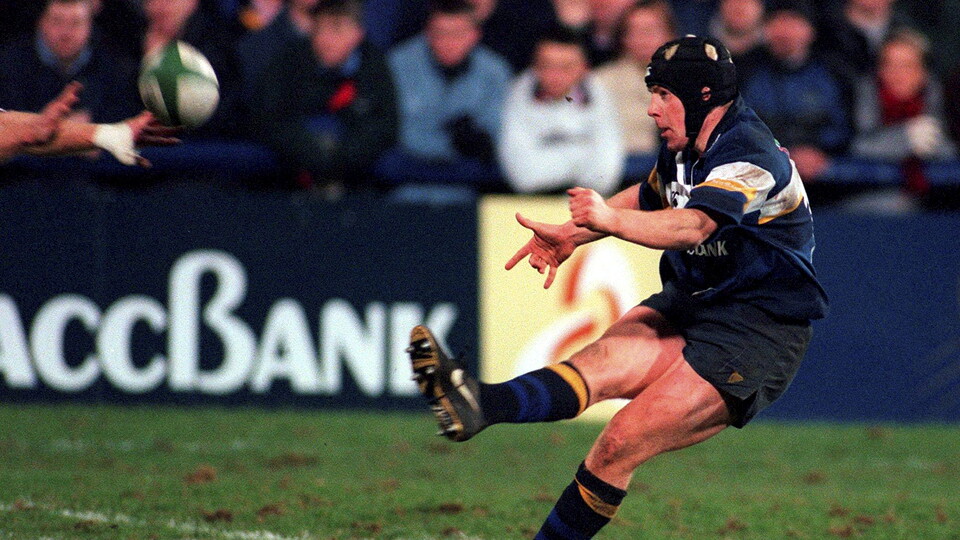
THEN: Mark made 15 appearances for Leinster between 1999 and 2001.
NOW: He is Head of Risk & Compliance for Flutter International, living in Howth with his wife Orlaith and three children Lucas (14), Jacques (12) and Elodie (8).
The odds of one boy from a non-rugby school climbing all the way to Ireland senior international status is a long shot.
Just ask Sean O’Brien and Tadhg Furlong.
The odds of two from the same year must be astronomical.
Shane Horgan and Mark McHugh were educated at St Mary’s Diocesan School in Drogheda where they were separated by a classroom, brought together at Drogheda RFC, now Boyne RFC.
Mark first picked up a rugby ball at two or three, began at the minis in Drogheda at six, following the examples set down by father Reggie and big brother Des.
“We were in the same year at school, not the same class, and Shane moved from Delvin at Under-14 to join us at Drogheda," says Mark.
“We played at Under-14, Under-16 and Under-18 together. I always enjoyed playing with him, me at scrum-half and Shane at out-half, centre and sometimes full-back.
“Listen, he was the best player on the pitch, no matter what position he played in. Simple as that.”
Remarkably, the first time Mark played out-half was at a Leinster Youths trial in Castle Avenue in 1996 where he stayed for the Interprovincial Series.

He was selected for the IRFU’s National Academy, the predecessor of the provincial Academies, joining Horgan and Brian O’Driscoll there.
That was a first step on the pathway to becoming a professional player.
Representing Ireland Under-18s in 1996 and 1997, the Leinster Under-20s in 1998, the Ireland Under-21s in 1999 and Trinity College in Division Three of the All-Ireland League formed his grounding at the elite end of the Age Grades and adult rugby.
While O’Driscoll and Horgan progressed quicker to Leinster, Mark wasn’t too far behind, making his debut for coach Mike Ruddock against Connacht in September 1999.
“Mike has always been a coach who has given youth a chance,” says Mark.
"I loved playing for Mike and loved coaching with him in subsequent years with Lansdowne FC. He's one of rugby's really good guys".
He earned seven of 15 Leinster caps in that first season, including starts against Leicester Tigers and Stade Francais in the Heineken Cup.
In fact, Mark led Leinster to a one-point win in Ulster on his first start and kicked 27 points in his second, a Heineken Cup debut, to humble the Tigers, giants of European rugby at the time at Donnybrook.
“It's fair to say that was the pinnacle of my time at Leinster,” he says.
“I would argue I was probably not the most mature 21-year-old. My ego got in the way. I didn’t apply myself as well as I could and should have in the following couple of years.
“In my view, it was part of the reason why I didn’t push on and establish myself more at Leinster.
“I didn’t have the maturity to keep myself grounded and know that I had to work my ass off to maintain my position and get better. People overtook me.”
The tag of being, for want of a better term, ‘a kicking out-half’ was one Mark would dispute. There was more to his game than boot-to-ball.
“A kicking out-half. I don’t think it is unreasonable to call me that,” he admits.
“Perhaps it does me a slight disservice. I could read a game pretty well and my passing game was relatively good.
“Where others had an advantage over me was around speed and agility. They were never my strong points and I probably didn't work hard enough to improve those areas. Even then, the game was about quickness”.
In 2001, Mark moved on to Connacht where he stayed for six seasons when Leinster declined to offer another contract.
“I loved Connacht. I loved living in Galway. I loved that we were more than the sum of our parts, most notably beating Leinster in Donnybrook in September 2002,” he says.
Mark doesn’t mention how his injury-time drop goal was the decisive blow that evening, handing Connacht their first win in Donnybrook for 17 years and Leinster their first home defeat since 1999.
Following some outstanding performances in the 2002/03 season, Mark was selected to travel on the summer tour with Ireland to Australia and the Pacific Islands.
It was there coach Eddie O’Sullivan awarded Mark his one and only Ireland senior cap against Tonga in June 2003.
In 2007, Mark wanted more than the one-year deal Connacht put on the table after two years of serious knee, hand and shoulder injuries which required six or seven operations from 2004 to 2006.
In his final season there, Mark never felt like the same player, feeling stale and in need of a new challenge.
This was provided by Montpellier where Mark played full-back with France heroes Louis Picamoles, Francois Trinh-Duc and Fulgence Ouedraogo.
“In January 2007, myself and my wife Orlaith got married and, when the offer came to play in Montpellier, we felt it was like a great adventure.
“It was a fantastic experience to live and play in the south of France, spending two years with Montpellier before making a lifestyle choice to move down to the Cote D'Azur to play for Nice for 2 ½ years”.
When the time came to listen to an aching body, 33-year-old Mark’s rugby retirement was accelerated by Nice going bankrupt mid-season.
“I’d love to say I had a plan in place. But, no, I didn’t,” he says.
“It was a very stressful time. I had an engineering degree from Trinity College which was 15 years old and we had two kids-under-two”.
In 2010, living in a small, quiet village outside Nice, Mark transitioned into working, initially as an unpaid intern, at a boutique wealth management company in Monaco, staying there for two years.
“At that point, we felt the pull of home growing stronger, returning to Dublin in September 2012, with no job and no real concrete plan for the future. Again, it was very stressful”.
There was the Irish Rugby Union Players Association (IRUPA), now Rugby Players Ireland (RPI), of which Mark had been Chairman for three years in the previous decade.
“I didn’t take advantage of the tools or mechanisms at my disposal at the time. I probably let my pride get in the way.
“You don’t want to admit to yourself, let alone the outside world, that you need some help. So, you don’t ask for help. In hindsight, it isn’t a great way to look at it.
“Looking back, I wish I had made a plan whether that was work placements, additional study and learning, or bringing my qualifications up to date”.
He worked in a small accountancy firm in the wealth management and pension space for six months, then applied for an internal audit role in retail banking at Permanent TSB, not really knowing what it was, and stayed there for six years.
In that time he also focussed on his professional development, achieving both stockbroking and accountancy qualifications.
“Any team sport gives you tools around teamwork and relationship-building skills, communication skills,” he states.
“The world revolves around personal relationships and the better you are at growing them, the more doors will open for you as you look to progress in your career”.
At present, Mark is Head of Risk & Compliance for Flutter International, a division of Flutter Entertainment (parent company of Paddy Power).
He keeps his passion for rugby alive as Head Coach at St Mary's College RFC.
“My view is that there are a tonne of players out there who have not earned enough from rugby to take their time in finding out what they will do next.
“I know all about it. I had three kids and no plan. It was a really stressful time,” he adds.
“Participating in elite sport has a very short shelf-life, so players need to ask themselves what they want to do when the 'cheering stops'? That is the question that needs to be considered.
"I'm 45 years old now and although it's taken quite the journey to get there, I feel I'm now in a good place with work, rugby and family.
“Our kids are sports-mad and Orlaith and I often spend any free time we have on the side of tennis courts or rugby, soccer and GAA pitches. While life is busy, right now, busy is good.
“But, for young players, who are living their rugby dream today, like I was able to do 20 years ago, give some thought to what happens when it's over and start planning accordingly."