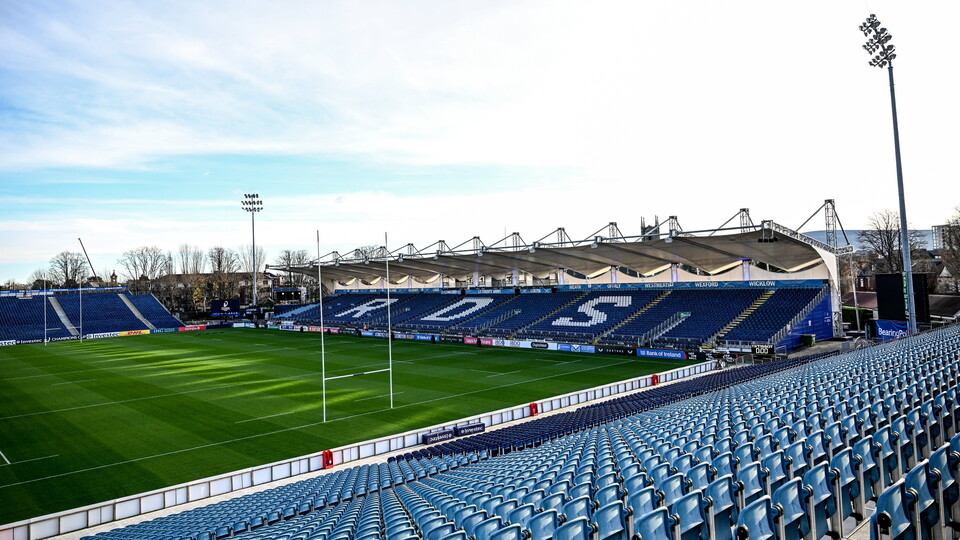
Ahead of this evening's final game in The RDS, Marcus Ó Buachalla looks back on Leinster's time in the fabled venue. You can read the full feature in this evening's Matchday Programme. €1 from each sale of the Programme goes directly to the IRFU Charitable Trust.
Established in 1731, the RDS Arena has had it’s fair share of songs and stories, and more than a few heroes of renown have passed through its gates.
As the sun sets on one last RDS Arena evening – at least for a while – it’s been an enjoyable few weeks reminiscing and looking back on the times that were.
There have been trophies won and great nights had, but when you sit back, and in particular when you talk to some of the main protagonists, it’s been about the moments, on and off the pitch, shared with teammates, coaches or fellow supporters wearing the same shade of blue, that stand out.
There have also been the urban myths. They too have popped up in conversation once or twice. You heard the one about it never raining in the RDS? That particular one belongs to one Michael Dawson, CEO of Leinster Rugby for over 20 years and the mastermind behind the move down the road from Donnybrook to Ballsbridge.
When he left his position in 2022, he looked back on his time in the hot seat and gave an in-depth interview about his time at the helm.

He was asked to reflect on the best decision during his tenure? An easy answer. The move to the RDS.
The first game to be played by Leinster at the RDS was in October 2005, a comfortable 34-15 win against Cardiff Rugby, but it wasn’t until two years later, that it officially became the home of Leinster Rugby when welcoming Edinburgh Rugby to the ground in the Magners League in September 2007.
There is no better place to start our look-back than with the former CEO and Lansdowne clubman.
“Donnybrook wasn’t fit for purpose anymore, that’s the truth of the matter, but there was a huge attachment to it as a ground and a venue and people enjoyed Friday nights in Donnybrook and a game and catching up with their mates, so there was an emotional attachment for Leinster supporters, for sure. It wasn’t an easy decision to move or look to move.
“However, the reality is that there were issues.
“The pitch itself for a start. It was used by Leinster, by Bective and Old Wesley and then by the Leinster Branch to host school games and club games. To then look to host high-profile league or European fixtures was just not sustainable. In August, the pitch looked like it could host a cricket Test match, it was that hard, yet in January it looked like it couldn’t host a rugby match. The players were also unhappy with it as a surface to play on, so it needed attention.
“Then the stadium itself with maybe 5,000 terraced tickets, but limited seating, it just wasn’t enough for what we wanted to do and in particular if we wanted to grow and evolve our commercial model. Quite simply, we had to do something. ”
It’s probably fair to say that it was an inauspicious start.
“That very first game was a Friday night game against Cardiff and we had to bring in floodlights from the UK through Rosslare. They arrived on a massive truck and we parked the truck on the back of the Anglesea Stand and hired a cherry picker and up the lights went over the stand.
“But I remember the director of outside broadcasting, John D. O’Brien, came to me about an hour before kick-off and said to me, ‘Mick, I don’t think this is going to work. The quality isn’t good enough to broadcast the game.’ I nearly started crying.
“Now he was probably right because Girvan (Dempsey), our full back, couldn’t see the far end of the pitch so John had a point! We took our lessons though and for the second game, we had two sets of floodlights hired from the UK but I remember they were delayed coming across on the ferry and then by traffic coming through Gorey.
“The stakes were even higher for that game as that was a European game against Bath and at one stage it looked like we’d have no lights. There was high drama but that was the type of logistical nightmare we were dealing with in those early days.
“Of course, in the years that followed, the RDS invested in floodlights, but also in the pitch and in dressing rooms and facilities and now it is one of the best surfaces in Europe to play rugby on and the players, and the supporters, love it.”
You can imagine the pandemonium, but Dawson recalls it all, in that brilliant manner of his, with a laugh and a smile, and you can sense the pride he feels in the RDS Arena that we see now in front of us.
It is hard to picture the mess back in 2005, when you look at the carpet-like surface that the Leinster and Connacht players will play on this evening, prepared lovingly by head groundsman Richard Doyle and his team.
Last weekend in Tottenham Hotspur Stadium over 60,000 watched Toulouse battle it out with Leinster.
On the 6th September 1997, 6,300 watched the same two teams battle it out in the old Donnybrook. There wasn’t a spare inch to be had. Sardines in a can. And Toulouse ran out 25-34 winners.
It may have been days like that in Donnybrook that convinced Dawson that the demand was there, that it just needed tapping into. Build it and they will come. Or even better, rent it and they will come.
In September 2007, Leinster played their first formal designated home game at the RDS Arena. 15 years later, in October 2022, as one of his last acts as CEO, Dawson signed a new 25-year lease.
It may have been the vision of Dawson to grow the fan base and the commercial arm of the club, but it needed that support base to buy into the dream and over the next few years, they did so.
By 2011/12 the Season Ticket Number had reached a record high of 13,086 and while that will be eclipsed next year with the move to the Aviva Stadium, it remains the benchmark for all other RDS seasons that will follow.