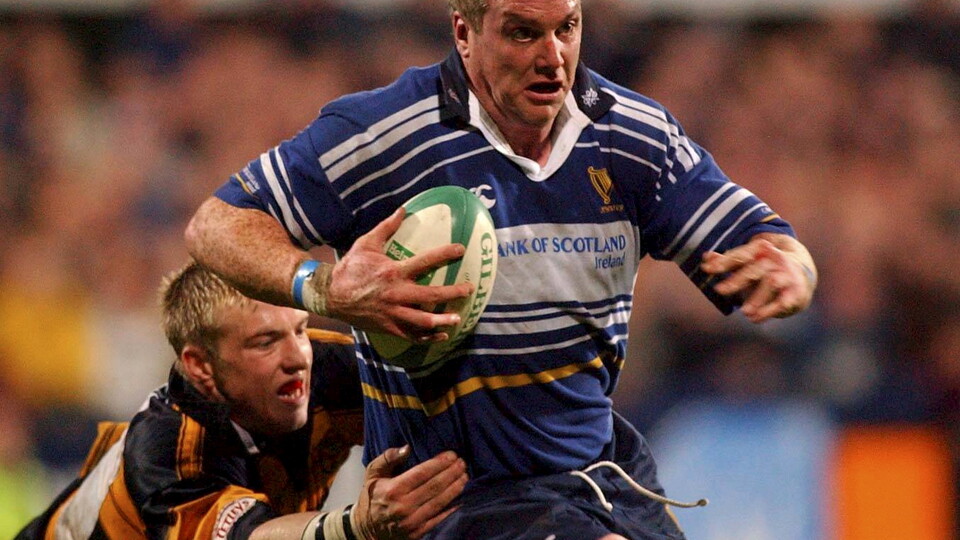
THEN: Victor played 121 times for Leinster through ten years from 1995 to 2005.
NOW: Based in Florida, Victor is a qualified pilot and the owner of Global Flight Training Solutions.
PART 1 - THE RUGBY PROFESSIONAL
Victor Costello was literally a boy among men.
At 16, the Stepaside manchild broke through as Irish senior shot-put champions for the first time, on the way to five Ireland National titles between 1987-1991 and the 1992 Barcelona Olympics.
That was enough. He dropped the sport.
“It was a privilege to represent Ireland at the Barcelona Olympics in 1992,” he starts.
“It was a dream to go to The Olympics. But, it wasn’t a dream to continue at the Shot Put. There was no chance of a medal.
“There was always a glass ceiling in athletics. I was never going to win the Olympics. The drugs and corruption were rife”.
There were the insurmountable, man-made hurdles and there was the lack of support that gnawed away at his core.
“We had unbelievable athletes in this country that all had to go to America to perform,” says Victor.
“When I was training with St Mary’s College under floodlights on Tuesday and Thursday night, the Irish athletic team was up in Belfield using car lamps to light the way in the winters of the 1990s.

“This is true. They had no facilities. No floodlights. For International athletes. Crazy”.
Victor had other options as a very unIrish explosive athlete with a ‘gra’ for rugby, passed on by his father Paddy of Bective Rangers, Leinster and Ireland.
The 6’4”, 250-pound number eight accrued 39 international caps as a unique difference-maker, who battled Ulster’s Brian Robinson and Munster’s Anthony Foley for the national shirt.
In the sliver of three seasons 1993-1996, Victor was educated in the values of the play-hard, party-hard attitude of the amateur game.
“It was different in rugby. Even though we moaned, we were looked after. The facilities were there,” he states.
“There was your club. There was Leinster. You stayed in a nice hotel. You had a team coach. You had a train to wherever you were going.
“We came from a culture of amateur rugby where you played your game and enjoyed a few pints afterwards. We called it bonding”.
“But it was real, the friendship, the camaraderie, win or lose we grew up together and, now, we grow old together”
The transition to professionalism in rugby was inevitable once the game turned in 1995.
There was a narrow window of time when you had a better chance of playing for Ireland if you were playing in England.
“That was the theory of the day until Courage League champions Wasps went down to Thomond Park and got their a&*es kicked 49-22 by Munster in the European Cup in 1996.
“That was the end of Irish players in England and the start of Munster,” notes Victor, returning from London Irish after just six months across the water.
“When I came back to Leinster in 1997, it was a different time. It was a different mindset,” he admits.
“We were nowhere near consistent enough. We were professional when we needed to be professional. We enjoyed ourselves when we could.
“If we got the balance better, things might have been different. We’ll never know”.
What Victor does know, from personal experience, is that when he needed Leinster, the club and its supporters were there for him.
It is very on trend for sporting organisations to adopt the umbrella description of ‘a family club’ to build a bridge to their supporters.
For Victor, Leinster has always been an extended branch of his family. When his father Paddy passed on in 1997, the club cared and the supporters cared.
“Leinster was very important to my family’s DNA,” says Victor.
“My dad Paddy, a Bective, Leinster and Ireland man, died in my mid-20s and Leinster were so good to my mother, Marie, not only when I played, but when I retired.
“She enjoyed the games more when I retired because she didn’t have to worry about injury to me.
“All the other parents, the Horgans, the Hickies, the Kearneys among them, minded my mother when I was in the States and she would go off to Leinster’s away matches with Paula Cullen and Carol Henderson when I wasn’t here”.
The catalyst for true change was the emergence of one player, a legend in the making - Brian O’Driscoll.
“When Drico’ came along, he was the next level. The rest of us were in survival mode. We all wanted to play with him.
“How do you do that? You win trophies”.
Leinster had already been labelled a soft touch for how they couldn’t win when it mattered most.
“At the time, we were called a lot of things, like chokers. You can say that. I won’t accept it,” he pushes”.
The shift in mindset began with the Celtic League in 2001.
When Eric Miller was sent off in the first half of the final against Munster, Leinster returned to the dressing room at half-time to be told one thing by coach Matt Williams.
“Everyone thinks you are going to lose this game”.
What followed was a phenomenal second-half performance in which Munster was mangled. It was a false dawn.
“We weren’t consistent enough on the other big days,” he says.
“The 2003 Heineken Cup semi-final against Perpignan was our biggest regret. We had that in the palm of our hands.
“Why did we lose? We had lost against England in the Six Nations. Our preparation wasn’t great. We made presumptions about playing a French team at home. We didn’t kick our points.
“Pick one or all of them. It doesn’t matter why. We weren’t ready”.
By 2005, Victor had to accept one immutable truth: He had had enough.
“I was national shot put champion at 16 years of age and I retired from full-time sport in my 34th year.
“When I finished my rugby in school at Blackrock College in May, I was doing athletics down in Nenagh, Armagh, Santry, Portugal until August when rugby started up again.
“The boys I trained with in rugby all had their own time in the summer to do what they wanted. I never had that break.
“But if you have a talent you need to maximise it. You can then leave your sporting career with no regrets.
“It is an honour to represent your country in any sport and to do so in rugby and athletics was doubly so.
“I just never had a break from elite sport for the last 20 years and there were other things I wanted to do. Athletes are always looking for challenges.
“When I retired after ten years, another Leinster number eight came along. And that’s tough s@~t!”
Leinster was still not ready to overtake Munster as Ireland’s pre-eminent province.
“I remember seeing Axel (Anthony Foley) and Reggie (Corrigan), my brother-in-law, coming out onto the pitch in 2006.
“I saw the fear in Axel’s face, God rest him, and I saw the Leinster lads enjoying the moment. I knew that was it. They put 30 points on us”.
The demand to win, pushed by Michael Cheika and O’Driscoll, came too late to salvage a European trophy for Victor.
“Once we got the monkey off our backs in 2009, everything changed,” he stresses.
“The foundations got stronger. The Academy got stronger. The coaching ticket got stronger and wider”.
The creeping of the years has rendered Victor a sympathetic father figure when it comes to Leinster’s current crew of characters.
He had to deal with the pressure of always losing. These men have to deal with the pressure of always winning.
“Nobody knows what these kids are going through, the dedication they have had to show since school.
“They have to deal with social media trolls, the media, the expectations, the winning, the losing.
“Players say they don’t read what people say or write. But, you hear it. If you get dropped by Leinster or Ireland, you can’t escape it. Everyone knows.
“You explain to your parents, to your friends. They are upset for you. They hate the coach, whoever he may be, even if you admit he is right. Then, the whole world sees it in the paper.
“And that was before social media”.
PART 2 - FLYING HIGH
“Why the f*%k am I not there?”
It is all Victor Costello could think of when the 2006 Heineken Cup semi-final came along.
He was less than a year retired, training to be a pilot, and watching a sell-out in Lansdowne Road from Florida.
“I was a forgotten man,” he says.
That day, he knew that no matter how far away he was from home, he could not escape the grieving that comes with letting go of something he loved so deeply.
“When you leave rugby, you need to be ready. It is impossible to do that. You cannot create the perfect retirement.
“It is either injury or poor contract or no contract or a trip to foreign soil. None of it is easy.
“When I retired, I didn’t hang around Dublin. I was gone. I would recommend that to most people. Get away.
“You are not missing the pre-season training. You are not missing the games. You are not missing the dressing-room craic”.
Victor could lean on the wisdom of his late father, Paddy, also a shot putter and Ireland rugby international.
“He had always reminded me that sporting success is ‘all for the glory of the moment.’ There are great moments, but they are fleeting”.
Eventually, the real world opens up and it can swallow a man whole if he is unwilling to adapt to life on the outside.
One evening, Victor attended a function with his wife Yvonne where he met multiple Olympic gold medallist Matthew Pinsent.
“I asked him: ‘How do you replace high intensity, elite sport when you retire?’
“His answer was: ‘You don’t! You don’t replace it. You have to find something else that tries to match it, differently.
“That is why I went into aviation,” he adds.
“Retirement isn’t easy, particularly the early years – moving from the incredible support system afforded to professional athletes to planning a career on your own.
“In rugby, as a professional sportsman, you learn about discipline. There is no working from home. No one is ever late.
“You learn to deal with success and failure, deal with the media, deal with people, be it supporters, kids or teammates.
“Your teammates expect a hell of a lot from you and you learn a hell of a lot about yourself,” he continues.
“When I go back to a Leinster reunion, I can’t kid the players I played with about what type of player I was or the person I am. They know”.
Victor knew what he wanted to do two years before he hung up his boots.
It was all based around facing a fear that had travelled with him and turning it into the driving force for his post-playing career.
“You have to have a plan. That plan might change. But, you have to have one,” he stresses.
“After the 2003 World Cup, I decided I wanted to be an airline pilot because I didn’t like flying.
“All my friends asked me: ‘Why did you become a pilot when you hated flying?’.
“I took lessons to get over the fear of flying. I was ably helped by Brian O’Hanrahan, a long-time airline pilot and close friend of mine, who I played with in school at Blackrock in 1987”.
It was this plan to become a pilot that had Victor seated in Florida when Leinster and Munster went at it in 2006.
“I trained to be a pilot over in Florida at the height of the Celtic Tiger and I was lucky enough to get into RyanAir in 2009.
“I went from Leinster where you have our ass kissed from your house to the training pitch, to the coach, to the airport, to the plane to play a game …to the demanding world of commercial aviation
“You learn discipline, punctuality, and team ethos from rugby,” he says.
You also feel the weight of pressure and responsibility when all is not as you would want it at the workplace - the pitch.
“There is nothing to compare with the meaning of team when you are stuck behind your posts at Lansdowne Road with 50,000 people watching your every move. That creates a team. You are lucky to have that. Not everyone does”.
In aviation, the sky is the pitch you work on and the landing strip is the scoreline that brings every flight to a successful conclusion.
“What does flying give you? A hell of a work ethic,” states Victor.
“You are in one of the most highly regulated, disciplined industries in the world where you are responsible for the safety of hundreds of people every day”.
From there, Victor began to build Global Flight Training Solutions, a broad-based, agile aviation company.
“We found an amazing base place in South West Florida, where we have a diversified business with interests in Jet Chartering, brokerage and providing concierge services
“It is hard work, hard work. You are never off. But, I love it. I have good friends, good advisors, my wife Yvonne being number one”.
These days, Victor is passionate about what he is doing, what young players have to do to play for Leinster and what they can do in their second career.
When the time comes for any player to step away from the game for good, he may sit in front of a prospective employer in a new industry.
“You don’t tell the interviewer, you were a professional rugby player. You tell him or her ‘I worked with the best in the world in my 20s’.
“I give them this simple piece of advice when dealing with their boss in a new career where you have to start at the bottom.
“You have to have the mindset: ‘Someday, I will do what you do. But, you will never do what I have done'.
“That is what gets you through”.