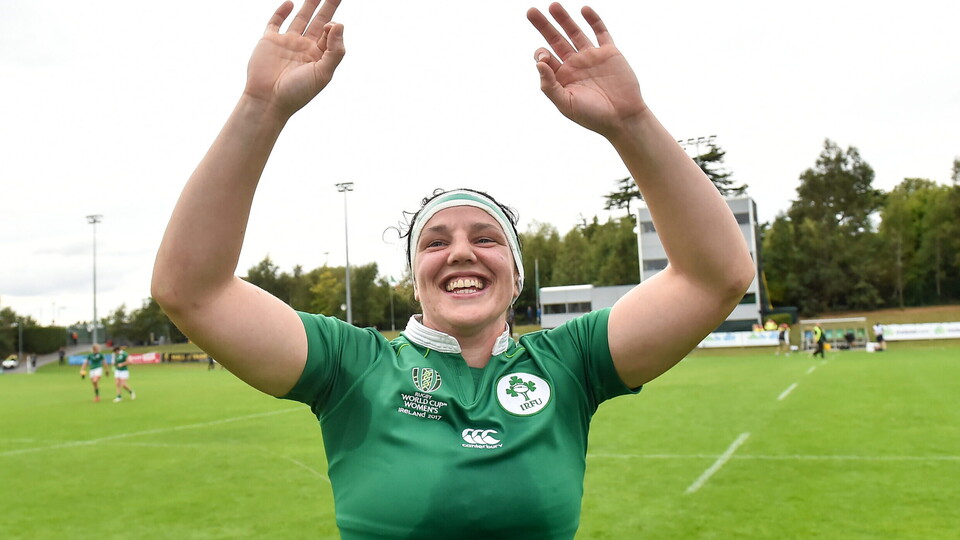
Former Leinster Rugby and Irish Rugby star Paula Fitzpatrick has opened up a window of time smack bang in the middle of a crammed schedule to share thoughts on the value of a physiologist in sport.
For those unaware?
A sports physiologist seeks to understand the physiological demands of a sporting performance, informing the characteristics an athlete should have to be successful in competing at the highest level.
This is the definition of the responsibility Paula holds - pictured below with the Team Ireland boxing coaches at the Olympic Village this week - for the Irish boxers at the 2024 Paris Olympics.
The 10-strong team joins the crew at the 1960 Rome Olympics as the largest boxing team ever to represent Ireland on the most exalted stage.
Ireland achieved the joint-third highest team number, greater than Cuba, the United States, Great Britain and Ukraine, all recognised powerhouses.
The ten pugilists, six women and four men fight for any advantage outside the ring where Fitzpatrick’s expertise is essential to how they perform.
Paula was not exactly your typical rugby player, turning out for St Mary’s College, Toulouse, Leinster, Ireland and The Barbarians throughout a stellar career.
Her leadership qualities were well-known and she captained both Leinster and Ireland at senior level.
However, in March 2018, the loose forward stepped away from the game to explore other challenges for stretching her mind and body to the limit.
“I decided to take a break for a year. I wasn’t sure if I wanted to come back,” she says.
Even then, The Barbarians pulled her out of retirement for two international tours to play against the United States in March 2019 and against Wales in The Principality Stadium in November 2019.
“I just wanted to try other things. Some people stop playing because they are sick of training or their bodies give in.
“It wasn’t like that for me. I love training. I still do it. I just wanted to see what else was out there”.
Sprint Triathlons, half-Iron Man’s, the Polar Marathon in Greenland, the Art O’Neill 53 km Ultra Event and the Irish Sailing and Mountaineering Adventure Challenge have kept her occupied.
The blessing of a curious mind has taken Paula on an academic journey, completing a BSc in Sports Science and Health from Dublin City University, an MA in Teaching and Learning from Sout-East Technological University Carlow and a PhD in Sports Nutrition and Exercise Physiology at Dublin City University.
This extensive academic background made Paula the perfect candidate to be a Performance Physiologist for Sport Ireland, prompting a half-time career break from lecturing in SETU Carlow in January 2023.
The role involves working with women’s hockey, athletics, rugby 7s and boxing, her primary responsibility for the duration of the Olympics.
Sometimes, just sometimes, it takes a high-performing athlete to help one.
“No matter the sport, the athlete must trust what you do to fully avail of the services. You build relationships over time,” says Paula.
“You need to help them to understand how physiology can benefit their performance. Once you do, the athlete tends to buy into it.
“The boxers have been brilliant. They are absolute professionals in everything they do. It has been an amazing experience working with them.
“It is a great environment to work in from the boxers to the coaches and the support staff”.
Paula is convinced her career as a high-performance athlete in rugby has given her an edge in understanding what is important in the pursuit of excellence.
And still.
“It is different. It is very much an individual sport. There is no one in the ring with them. They are on their own in that sense,” she declares.
“However, there is a lot of support outside the ring for them, both from their teammates and from the support staff”.
Paula covers training load monitoring, recovery, hydration testing, sleep skills and heat preparation, among other things.
At present, she has no regular commitment to rugby. But, she does represent Ireland in Masters (Over-35) hockey, preparing for a World Cup in South Africa in October.
Certain human traits ring true in individual and team sports.
“It is about the simple things,” says Paula, capped 41 times for Ireland.
“You can have all the tech in the world. You can monitor this and that. Sometimes it is about how your body feels and trusting the process.
“I was lucky enough when I was a player I was studying Sports Science in DCU before I did a PhD. I would have picked up a lot of the information and skills through my studies.
“That was useful for me as a player,” she states.
“You learn what the evidence and scientific literature is in college. You have to weigh that against what is going to work practically in the real world.
“You can have the best nutrition advice in the world. But, it might not work for everyone.
“The best piece of advice for players is to find out what works for them, to trial it out in training and implement it as best they can”.
As the Leinster Women prepare for the Interprovincial Series which starts on August 10th against Connacht in Energia Park, Paula stresses the value of a competition that provides a bridge between club and international rugby.
“It was crucial in my development to play for Leinster,” she shares.
“When I first got into the set-up, what benefited me the most was the opportunity to play with internationals at the time.
“We had the likes of Fi Coghlan, Tania Rosser, Grace Davitt, Shannon Houston, Caroline Mahon, all these stalwarts of the game.
“I was able to train with them, learn from them. You saw what they expected of themselves and what they expected of you. You saw the knowledge they had and you got the benefit of it.
“I didn’t necessarily have a view of playing for Ireland. I was just delighted to make the provincial team at the start. But, I learned a huge amount from the players that went before, not just in how to play the game and how to handle different scenarios in the game.
“You also learned how to conduct yourself and what it meant to be a provincial player and, in time, an international player”.
At the moment, Paula has no direct involvement in rugby.
“It is obviously a sport I am hugely interested in,” she admits.
“I do think the professionalism element is brilliant. It is nowhere near equal to the men’s game. But, there have been huge strides made to bridge the gap.
“The biggest change you get with professionalism is on rest and recovery.
“In the time I played, we weren’t professional in financial terms. But there was huge professionalism in everything we did, in terms of training.
“You did have to balance that with education, full-time careers, families and all those interests outside the game. Professionalism is removing those barriers," adds Paula.
“You have the time to devote to rest and recovery. You don’t have to worry about getting to your nine-to-five and having to negotiate for time off from work to play international rugby.
“A big benefit of professionalism is that element of having extra time to recover, to do video analysis and all the extras that can make a difference”.