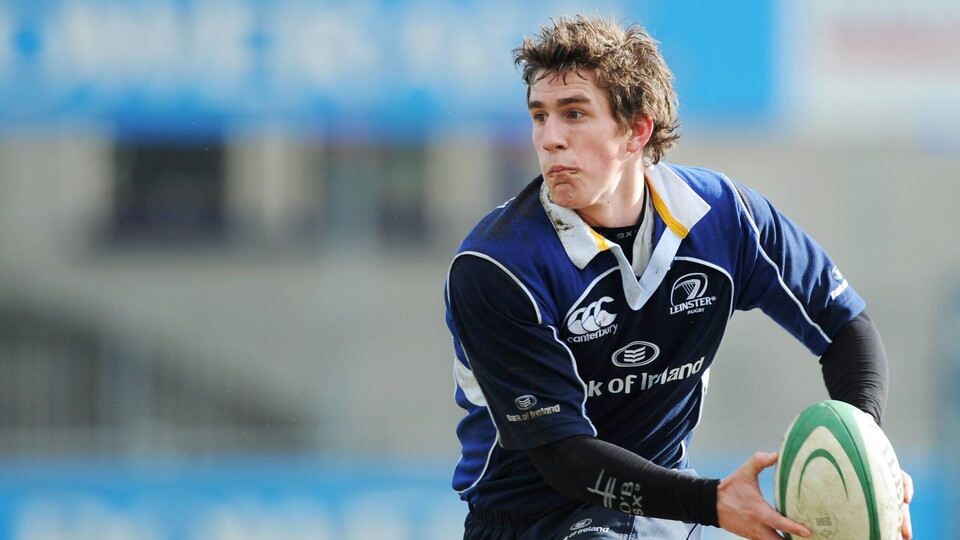
THEN: Although he never played for Leinster, Ian Keatley amassed 288 caps for five clubs and seven Ireland caps in his career.
NOW: He lives in Limerick with his wife Lisa, daughter Beth (7) and son Quinn (4), working as a Provincial Talent Coach for Munster.
Purpose. It is what has driven Ian Keatley all along. Although it took retirement from the game to remind him of how precious and fundamental it is to his mindset.
The ex-Ireland out-half steered a talent-packed Belvedere College group to victory in the Leinster Schools Senior Cup in 2005, bridging a 33-year gap back to Ollie Campbell’s crew, he would become one of five professionals.
Cian Healy, Eoin O’Malley, Paul O’Donohoe, Peter Woods, and Keatley himself. Only two did not go on to play professionally for Leinster. Keatley was one.
In 2005, he joined coaches Colin McEntee, Dave Fagan and Richie Murphy in the Leinster Sub-Academy for one year before progressing to the Academy proper for two years. But a mysterious back injury halted his progress.

Connacht’s Eric Elwood and Dan McFarlane — who were coaches on the 2007 Ireland U-20 team who won the Grand Slam with Keatley at 10 — along with Michael Bradley expressed an interest in taking the young out-half to Galway in 2008.
Felipe Contepomi and Christian Warner were in place at Leinster and Isa Nacewa had just been signed to be a third out-half.
Patience can be a virtue. It can also be a career killer. Leinster wanted Keatley to stay. There were no promises attached.
“I know some would say I should have backed myself,” he says.
“It was such a hard decision. You want to stay at the province where your whole family and friends are from and for the team you grew up trying to play for. It is all you want to do.
“There is another side to it. Do you want to have a long career? Do you want to grow and develop quickly?
“I had the choice between a third year in the Leinster Academy or a full contract at Connacht where there was just one other out-half; Andy Dunne.”
The ambition to play trumped the dream to play in blue. Keatley turned out 25 times in that first season and earned the first of seven caps for Ireland against Canada in May 2009.
Ultimately, Keatley gathered 77 caps for the western province over three seasons. Connacht offered Keately a two-year deal in 2011 but Munster were interested following the departure of Paul Warwick. At Leinster, Joe Schmidt wanted competition for Jonathan Sexton and Ian Madigan.
“The IRFU inserted a stipulation that no matter which province I chose, it would be for the same contract value because they didn’t want the provinces getting into a bidding war,” he says.
“I took off my home and heart hat and put on my career hat, knowing Ronan O’Gara wasn’t going to be around for much longer.
“I ended up going to Munster and spending seven and a half years there where I picked up 180 caps.”
Was it difficult following in the footsteps of O’Gara? “Yes, it was. He is one of Ireland’s greatest players. I didn’t play the same way as Ronan,” Keatley says.
“While I was there, I had to change my style, kicking more tactically. I worked so hard to change my game.
“I probably sacrificed my natural running game in the process. If you are a ten, you want to get picked. You do what the coaches tell you to do”.
At the end of the 2017/18 season, Munster coach Johann van Graan told Keatley how he’d had a brilliant season.
Keatley never started again under Van Graan.
From there, he played for London Irish in the English Championship for six months (2019), Benetton for 18 months (2019 to 2021) and Glasgow Warriors for six months (2021).
Then it was time for Keatley to figure out what was next as he hung up his boots. It wasn’t easy.
The removal of the day-to-day routine, the dressing-room, the camaraderie came as a shock to the system.
“I found finishing rugby very hard. I struggled with it,” he admits.
“I had been playing rugby for 16 years. I couldn’t see myself settling into a nine to five desk job.
“You are trying to transform your life from being a rugby player to being a rugby coach. It is like going back to college when you are 34 years old.
“At school, you are told what to eat, what to wear, where to be. You come out and go straight into rugby where it is the same.
“It is very structured. Everything is planned out. All of a sudden, that is gone. You are on your own.
“Okay, I got to play golf. But you can’t do it every day. There is no structure. There is no routine. I was on my own during the day and when Lisa, my wife, and the kids came home I was on my way out to coach in the evening.”
He needed to rediscover his purpose.
Keatley managed to get his foot in the door at Munster and impressed enough to be rewarded with a two-year contract as a Provincial Talent Coach.
When an old friend came calling, he was delighted to accept an invitation to join the Ireland U-20 coaching team last season.
“Richie Murphy was my first coach at Leinster. I used to go kicking with his two sons Ben and Jack when they were very young,” he says.
“It came full circle when Richie asked me to join the Ireland U-20s and Jack was the out-half.
“I really enjoyed the role, dealing with really hungry, goal-driven, talented players, who wanted to learn.
“When you are an out-half, you feel like a coach on the team.
“It was what I knew. It felt like the natural progression to step from player to coach. I thought I would be good at it.”
Looks like he might be right.