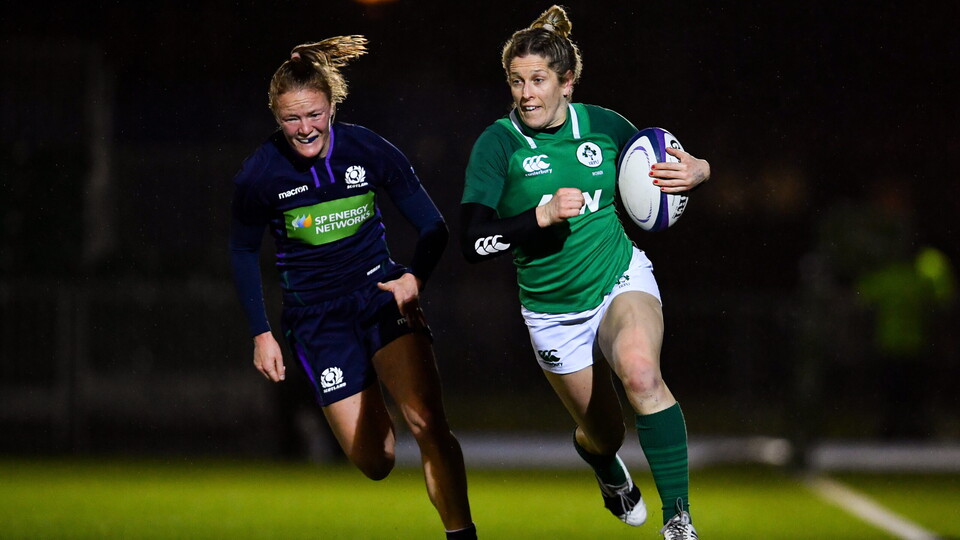
THEN: Alison Miller is Ireland Women’s record try-scorer, with 24 tries from 47 international caps.
NOW: She lives in Laois with her husband Alan and her daughter Ruby (3), working as a PE Teacher at Athy College.
Alison Miller was the one who got away. And never came home.
The Portlaoise woman was a decorated athlete and an inter-county footballer before she became Ireland Women’s greatest winger.
When she decided to retire from international rugby in 2019, her achievements included a record-setting 24 tries from 47 caps.
A decade at the elite end of the game began with her debut for Connacht in 2009 where Miller stayed and played – out of loyalty.
Why did she never play for Leinster? “I didn't get picked at trials and no one ever asked me after that,” Miller explains.

From the moment she struck for a try against Italy on her international debut in the 2010 Six Nations to the hat-tricks against England in 2013 and Scotland in 2015 and 2016, no one at Leinster thought to invite Alison home.
“I am from a GAA family. But, I had an athletics background,” she says.
“My mam, Carol, was a PE teacher. My dad, Bobby, played inter-county football for Laois. I did ballet, gymnastics, basketball, hockey and volleyball.
“I was highly involved in athletics, 400 metres hurdles, long jump, triple jump, 800 metres. It took up a lot of my training time. I won All-Ireland Schools titles and represented Ireland two or three times.”
Deep down inside, Miller knew that athletics could be the base for being great at something else.

“I was pragmatic. I always knew I wasn’t good enough,” she says.
It was then that Miller began to play Gaelic football. One year with her local club Ballylinan led to two years of inter-county football with Laois.
In the summer of 2007, her father passed away after suffering a heart attack while on the sideline as Arles-Killeen played The Rock in the Laois Senior Football Championship at O'Moore Park on a Saturday evening.
Alison had travelled to the game with her dad, and returned home without him.
“It was totally out of the blue. He was a fit, healthy man, just 55. It was a complete shock to everyone in the community and our family,” Miller recalls.
“All you can do is carry on. You’ve got to get up, get dressed and move on.
“When something like that happens, it puts everything in perspective. You realise how short life can be.
“You should not let anything hold you back from doing what you want.”
The same year, Miller made the county team and took up rugby at Waterford Institute of Technology, where Niamh Briggs was a teammate.

“I was probably looking for a bit of a distraction from what had happened with Dad,” Miller says.
“My two friends from college, Andy McBride and Shane O’Rourke, had been encouraging me to play rugby. They thought I was made for it.
“Immediately, I loved the pace, the physicality, the freedom of it. I had speed and I had strength from athletics. I could outrun people. I could overpower people.
“Now, I hadn’t a clue what was going on. I was told where to stand and what to do. When I got the ball, I would just go.
“When it came to the technical terms of the game, I had everything to learn. Waterford IT was the perfect place to start playing rugby.”
The next logical step for Miller was to move to Portlaoise Rugby Club where an old friend, Yvonne Delaney, was waiting with open arms.
“You have found your sport,” Yvonne told her.
How right she was!
Coach Gordon Matthews pushed Miller to attend Leinster trials. Somehow, and for whatever reason, she slipped through the cracks.
Leinster’s loss, Connacht’s gain
“I didn’t get invited back. That is how the long road to Connacht happened,” she says.
“When I look back at the Leinster experience, I remember a lot of drills, no contact. I was very raw and green, not the most skilful. It just didn’t pan out.”
More than that, the competitive instinct kicked in for the athlete known for breaking the tape in first place.
“I was really pissed off,” she admits.
Miller remembers a conversation with her mother in which she committed to proving those coaches at Leinster wrong.
She drove out west to Connacht to answer a Facebook advertisement for an open training session.
In her first full-contact trial game, she scored four tries. Coach Lyndon Jones saw enough to know she had a future.
In fact, Miller played just one Interprovincial match before being invited into the Ireland camp, scoring a try on her international debut against Italy in the 2010 Six Nations at the age of 25.

“It probably suited me to go the way I did,” Miller says. “Leinster had enough players. They didn’t need me. Connacht weren’t that strong at that time. They needed me more than Leinster.”
It has left Miller with a strong opinion on talent spotting.
“I always say to people, you have to find those athletes and keep them in the system. They might not be ready right now. But, in time, that can all change.”
What didn’t change was Miller’s commitment to Connacht.
“I am a loyal person. I was given my opportunity by Connacht,” she says.
“I appreciated what Connacht did for me, fast-tracking my development. It would have taken me longer to break through at Leinster.
“Sometimes what’s for you won’t pass you.”

These days, Miller is a physical education teacher at Athy College where rugby is not high on the list of the school’s priorities. That doesn’t mean the benefits of playing the ultimate team game have been lost.
“Sport was always a big part of my life growing up,” she adds.
“You get used to being critiqued as a means of getting better. You improve by being open to working on your weaknesses.
“In teaching, you have to be able to deal with different personalities in one classroom. It is similar to team sports in that way.
“There is a ‘cool’ element to it. The kids look you up. They have respect for what you have achieved. They are impressed by it. You can use that to your advantage.
“Even though I am retired, I have dipped into coaching in GAA and rugby. I might like to coach in the future.
“I am not sure about it yet.”