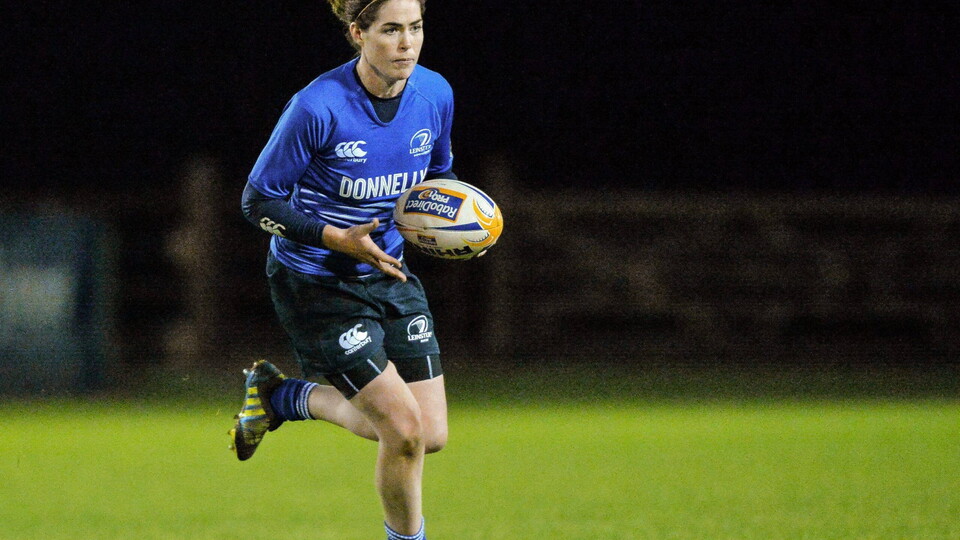
THEN: As well as representing Leinster and earning 50 caps for Ireland, Nora Stapleton played Gaelic football for Donegal and soccer for UCD.
NOW: She lives with her wife Claire, their son Noah (5) and twins Senan and Luca (2), in Ballinteer, working as a Director for Sport Ireland.
All of her life, Nora Stapleton has been a late starter.
The former Old Belvedere, Leinster and Ireland out-half is a 50-cap international veteran of three Rugby World Cups (2010, 2014 and 2017). But before rugby percolated through her life, she had already been celebrated as a Donegal senior inter-county footballer and a decorated member of the UCD soccer team which won three successive FAI Women’s Cups between 2002 and 2004.
“I guess you could say I am, or was, decent at playing most ball sports,” Stapleton says.
“My parents weren’t really into sport. They had kids to raise and jobs to hold down. It wasn’t as if I was being introduced to pathways. I didn’t know anything about inter-county panels or under-age Ireland squads, other than men's teams.
“I remember my granny bringing me to Croke Park for the All-Ireland semi-final and final in 1992 when Donegal won. That was pretty special. That probably leant to me being quite late to sport, in terms of representative honours.”
Everything the Donegal-born girl from Fahan, near Buncrana, has played, she has discovered for herself. It was never handed down.
“I played whatever happened to be going on at the time. I had a great teacher in primary school, named Manus O’Donnell. He was so enthusiastic about sports,” she says.

“I think the first time I ever went to proper training for anything was for basketball in secondary school. It was not the way it is now for kids where you go to the club or Academy from the age of four. I just bounced between all the sports and played whatever match or ran in whatever race I was brought to.
“I think I got most of my skill from back garden football. My best friend was a fella. He had brothers. We played football until dark. It was all just ad-hoc.
“My uncle too was only a few years older. I played in goals with him and his friends, usually getting pelted with the football.”
When she moved to Dublin for college at UCD, Stapleton called her mum worried about having to go to trials to join some of the sports teams. Trials.
Everything was foreign. From the big city to the commitment to Gaelic football and to soccer, taking up most nights of the week.
“I was suddenly playing with county players from all across the country,” she says.
At the end of first year, UCD made and won the O’Connor Cup final. After the final whistle, an opponent asked her if she was from Donegal and if she’d mind if her number was passed on to the manager.
Twenty minutes later, Stapleton received a call inviting her to senior training in Donegal the next evening. And that was it.
At the same time, she was busy playing soccer for UCD, qualifying to play in the UEFA Women’s Cup — a tournament which has since been rebranded as the UEFA Women's Champions League.
There have been magical moments along the way.
“I got to play in Croke Park in the All-Ireland Junior football final, losing to Galway in 2002,” Stapleton says. “That was an amazing memory. The noise. The atmosphere.
“Winning the FAI Women’s Senior Cup for three years in a row was incredible. We had Ireland internationals, like Niamh Connolly, Caroline Thorpe and Mary Waldron.
“It’s nice to be able to say I’ve played in the biggest stadiums in three different sports; Lansdowne Road in soccer, Croke Park in Gaelic football, and the Aviva in rugby.
“They were interesting times. I played against Katie Taylor when she was with Peamount and Ireland’s record goal-scorer Olivia O’Toole.”
In 2006, aged 23, Stapleton went down to Old Belvedere to play what the coach called “real rugby” for the first time.
You could say she was late to the game. Again.
“I was used to getting my head up and seeing what was available down the pitch from Gaelic and soccer,” she explains. “It came as quite natural to see space and to go after it.
“We worked our way up from Division Three to win three All-Ireland League titles from 2013 to 2015.
“Some of the wins with Old Belvedere and Leinster rank up there, particularly the time we won the Interprovincial Championship against Munster in Thomond Park in 2013.
“The first time I went for Leinster trials was in 2008. I broke a rib up near my collarbone in a tackle. I will always remember the pain, mainly because I played a Donegal match a few days later which was agony.
“My debut for Ireland came in the 2010 Six Nations against Italy. Myself and Ali Miller got our first caps together on the wings. I was fine there but knew it would never be my long-term position, especially after the 2010 World Cup. I learned how much better and faster I needed to be if I was to play there.
“In 2011 — this might sound crazy — I played out-half for Ireland before I had even played there for my club. I was playing in the centre for Old Belvedere, doing a lot of the shouting and direction. Ireland didn’t have a clear out-half.
“At training, I stepped forward and offered to play the position. It was where I wanted to play and where I felt I could add value.
“My standout memory was beating England 25-0 at Ashbourne on the way to the Grand Slam in 2013. There was a lovely feeling that day of being in control of a game. Looking up at the scoreboard at the end brought an amazing feeling.
“Ireland had spent so many years trying to reduce the margin of defeat to England and France.”
Then, they became the first Ireland team to beat New Zealand at any level at the 2014 World Cup.
At the 2010 World Cup, Stapleton swapped pins with one of the New Zealand players. When the draw was made for 2014, she found the pin and put it in her gear bag as an everyday reminder of the goal to beat the Black Ferns.
The dream came through in France when Niamh Briggs’s penalty secured a remarkable victory.
“Our coaching group was inspiring,” she says. “They instilled immense belief in us. You would have done anything for anyone that day.”
When all was said and done, Stapleton retired from the game at the end of the 2017 World Cup at the age of 34.
“I have been working in sport for about 17 years,” she says. “When I was playing Gaelic football for Donegal, I was a Game Promotional Officer with the GAA. When I started playing rugby, I became a National Women and Girls Development Manager for the IRFU, playing for Ireland and working in the Union.
“I was part of putting the bid together that brought the World Cup to Ireland in 2017, looking after the legacy plans and rolling it out before handing it over to someone, so that I could fully concentrate on playing for Ireland in the competition.”
In 2019, Stapleton became the Women in Sport Lead for Sport Ireland, covering all female sports, rather than being restricted to just one.
“I have played many sports. It’s not like I came up through one,” she says. “I love anything that gets me moving, running, kicking and jumping, especially if there is a ball involved.”
The transition from playing and working to just working is a different challenge to that faced by the men.
“The men have to restart and fill their whole space whereas, for us, it is more about life going on with a big chunk of it missing,” she says.
“That part of your identity where people might recognise you is gone. The reasons for staying fit and healthy are gone. You have to find another reason to activate that part of yourself. You used to train to get better to win. I found that hard.
“The values I took from the game are hard work, dedication and appreciating the final product of whatever you are working on, getting a sense of achievement from doing something well.
“There is also the ability to balance multiple jobs at the same time because you had to do it through your rugby career.”
This interview originally appeared in the match programme for our United Rugby Championship clash with the DHL Stormers. If you missed a copy at Aviva Stadium, you can still purchase one here. €1 from the sale of each programme goes to the IRFU Charitable Trust.