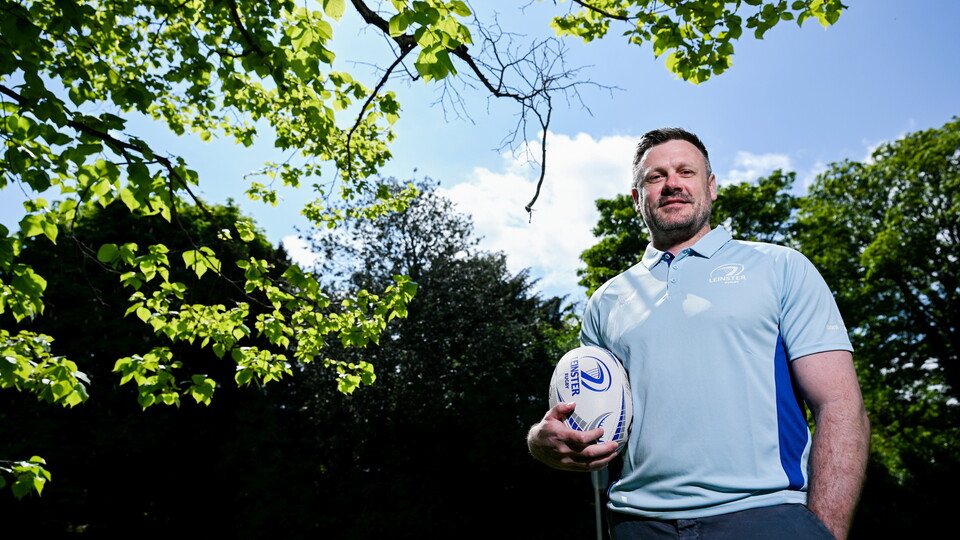
Ben Martin is in the enviable position of taking over from Tania Rosser's well-oiled machine as Leinster Rugby Women’s Head Coach.
However, the new role also brings with it the pressure to maintain Leinster’s stranglehold on the Women’s Interprovincial Championship.
The bid to complete a three-in-a-row in the four-match series aligns with the overarching theme of player development.
What of Martin though and his own development to this point?
He has been involved in women's rugby on and off for the last 14 years.
In 2011, the life of the travelling rugby professional had taken him on the Sevens circuit with Australia, to UL-Bohemian and Colomiers in France. He returned from playing for the 1999 European Cup finalists in the Pro D2 in France, an ankle problem forcing him to retire from the game at 29.
Back at UL-Bohemian, his friend Gary Walsh was named Head Coach of the powerhouse Women’s All-Ireland League team. He invited Martin to join the coaching team. Familiar faces like Niamh Briggs and Fiona Hayes encouraged the transition. It led to a time coaching Munster.
“My last involvement with a provincial side would have had players with an average of three to five years of training age, when they may not have picked up a rugby ball until getting into college,” Martin explains.
“There is a vast difference in rugby knowledge between that group and the current Leinster squad, which helps in the tactical implementation we are looking for. For example, we carried out an individual development programme for where the players’ skills are at, in terms of technical and tactical understanding.
“In there, was a question asking how long the players have been playing rugby, primarily for my curiosity, to find out their different training and playing ages. It was surprising to discover how many of the younger players had eight, nine, ten-plus years of rugby experience, which is brilliant.”

“When you coach women, you have to dig down into the ‘why’?” he says. “It caught me by surprise when I first moved into that environment in 2011. I still remember sharing my explanation of a play to the wider group.
“When I had finished showing how the play worked, I was immediately asked: ‘Why are we doing that when there is space over there?’
“It led me to question my philosophy. I had to know the reason behind the play. I soon learned, if they understand and believe in the why, the double-down and buy-in is phenomenal.”
The affable Australian led UL-Bohs to the 2019 All-Ireland League crown and moved on to Blackrock College to drive back-to-back appearances in the AIL final, winning the title in 2022. There was also a season with the Exeter Chiefs Women in the English Premiership to add outside experience.
Last season, conversations with the IRFU led to an involvement with the Wolfhounds in the Celtic Challenge, where he has the role of Backs and Attack Coach, and was central to 10 wins out of 11 matches.
Tania Rosser’s departure left a space Martin was delighted to fill, after consultation from Leinster Coach and Development Manager Declan O’Brien and Coach and Development Officers Damien McCabe and Robbie Mullen.
The familiarity of the Wolfhounds, which contained a cluster of Leinster players, convinced Martin to accept the offer to lead Leinster into the Vodafone Women’s Interprovincial Championship.
“We’ve got a really good group of players. That will test me as a coach,” says Martin.
“The Leinster Way is a broad brush description for fast, dynamic rugby, which can be designed and installed in more than one way.
“Do coaches come in and instill their philosophy because that is what they know? For me, it is more about the playing group, how and what the group wants to achieve.

“With the World Cup on the horizon, it is a different group to what has been there for the last two or three years. It allows the opportunity to change the way we do things, whether it is the Leinster Way or my way or an amalgamation of those and how the girls see the game.
“The players have to buy in. They have to understand it. They have to want it. I had a lot of rugby philosophy conversations with my players at Blackrock and the Wolfhounds when I came back from Exeter Chiefs.”
The commitment to cast the net wide resulted in 67 players attending the first four training sessions, including the Ireland Under-20 squad members scheduled to leave for the Six Nations in July.
Thereafter, the numbers will be cut to 35, plus those in the NTS (National Talent Squad), taking the overall tally to between 42 and 45 players, depending on performance in those two weeks.
When the Ireland U-20 players return, there will be an internal trial to decide which players compete through August for a place in the Interprovincial Series.
While the coaches and players work towards retaining the Championship, the short burst of four matches also serves as a developmental space.
“Development and winning go hand-in-hand,” Martin says. “The better you can prepare players individually, the better you can prepare your tactical game plan, the better they can execute it. That gives you a better chance of winning.
“I am the most competitive person alive.
"I want to win. Absolutely. But, if we fall short of that goal, and there are five players outside of the NTS or one of the big clubs that get taken into the Wolfhounds or an extended Ireland squad, then we can take satisfaction from playing a part in those players’ progression.”